Kona delivered another dramatic men’s race on a day when rain, humidity and wind made the island harder than in recent years. Vincent Luis won on his Kona debut, in the last race of his career, after a patient day that saw him start the marathon almost six minutes behind Magnus Ditlev, who led for most of the bike and run but struggled in the heat and had to stop about eight kilometers from the finish. Gustav Iden and Matthew Marquardt finished second and third despite three-minute penalties.
| Rank |
Name |
Nation |
Swim |
Bike |
Run |
Time |
Diff to exp. |
Prize Money |
| 1 |
Vincent Luis |
FRA |
00:48:31 (13) |
04:15:42 (10) |
02:38:36 (2) |
07:47:27 |
-08:06 |
US$ 125,000 |
| 2 |
Gustav Iden |
NOR |
00:50:10 (27) |
04:17:10 (13) |
02:36:58 (1) |
07:49:03 |
-08:31 |
US$ 65,000 |
| 3 |
Matthew Marquardt |
USA |
00:48:25 (3) |
04:11:28 (4) |
02:43:58 (8) |
07:49:59 |
-12:50 |
US$ 45,000 |
| 4 |
Gregory Barnaby |
ITA |
00:50:10 (27) |
04:11:23 (3) |
02:44:44 (9) |
07:51:02 |
-13:17 |
US$ 25,000 |
| 5 |
Pierre Le Corre |
FRA |
00:48:29 (8) |
04:20:47 (18) |
02:38:50 (3) |
07:53:29 |
-13:46 |
US$ 20,000 |
| 6 |
Sam Long |
USA |
00:54:47 (42) |
04:12:50 (7) |
02:42:57 (7) |
07:55:21 |
-16:37 |
US$ 18,000 |
| 7 |
Jonas Schomburg |
GER |
00:48:34 (19) |
04:21:31 (23) |
02:41:45 (5) |
07:56:42 |
00:35 |
US$ 15,000 |
| 8 |
Kristian Blummenfelt |
NOR |
00:48:48 (24) |
04:15:06 (9) |
02:49:06 (14) |
07:58:07 |
02:19 |
US$ 13,000 |
| 9 |
Youri Keulen |
NED |
00:48:32 (15) |
04:22:30 (24) |
02:42:05 (6) |
07:58:26 |
-08:26 |
US$ 12,000 |
| 10 |
Menno Koolhaas |
NED |
00:48:18 (2) |
04:20:37 (16) |
02:45:31 (11) |
07:58:55 |
-02:21 |
US$ 11,000 |
| 36 |
Marten Van Riel |
BEL |
00:48:17 (1) |
04:16:14 (11) |
03:32:49 (38) |
08:42:18 |
45:50 |
|
| |
Magnus Ditlev |
DEN |
00:50:18 (30) |
04:06:47 (1) |
|
DNF |
|
|
| |
Sam Laidlow |
FRA |
00:48:33 (17) |
04:10:08 (2) |
|
DNF |
|
|
| |
Patrick Lange |
GER |
00:48:29 (8) |
|
|
DNF |
|
|
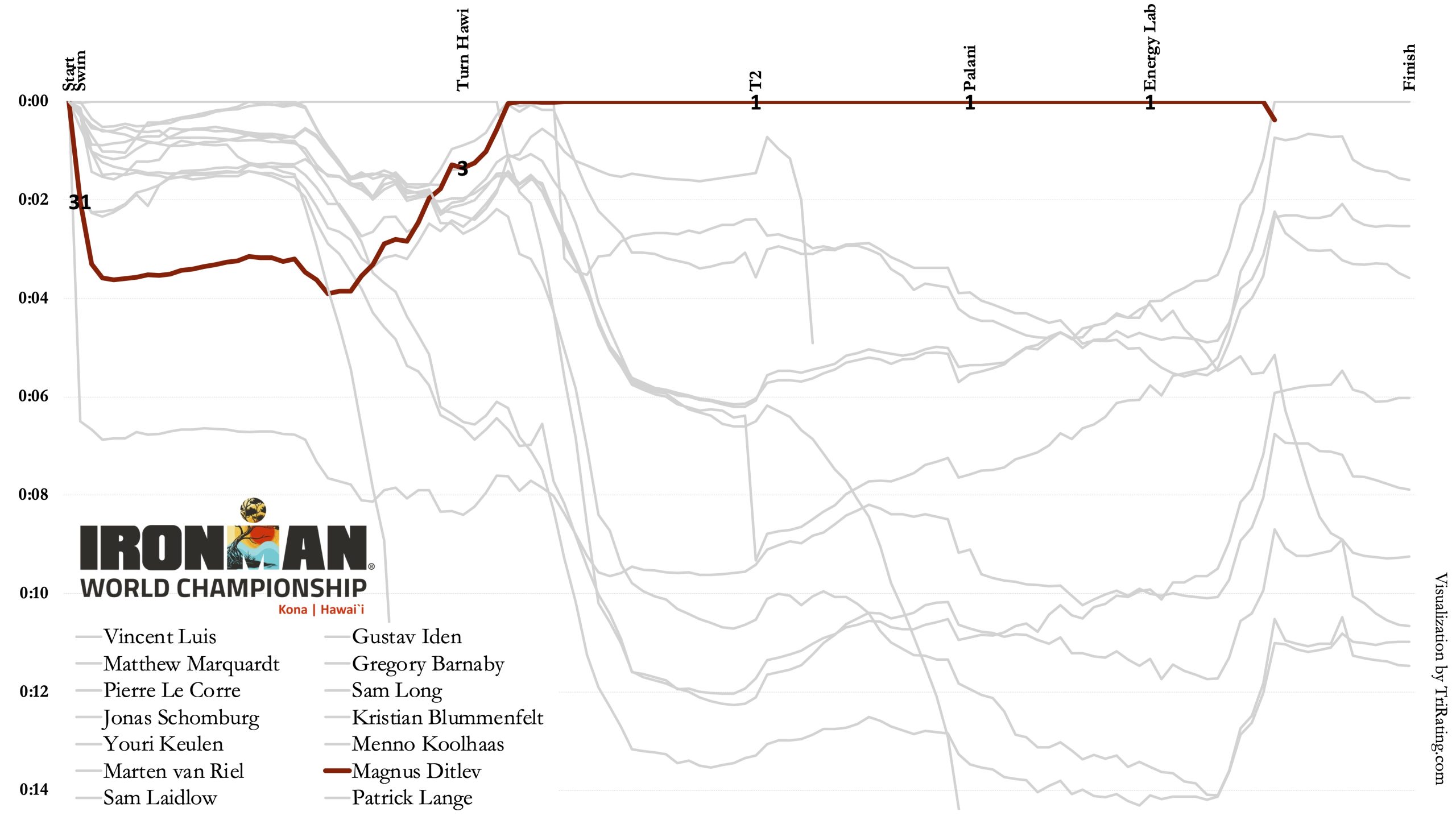
Here’s a graphical view of the race development:
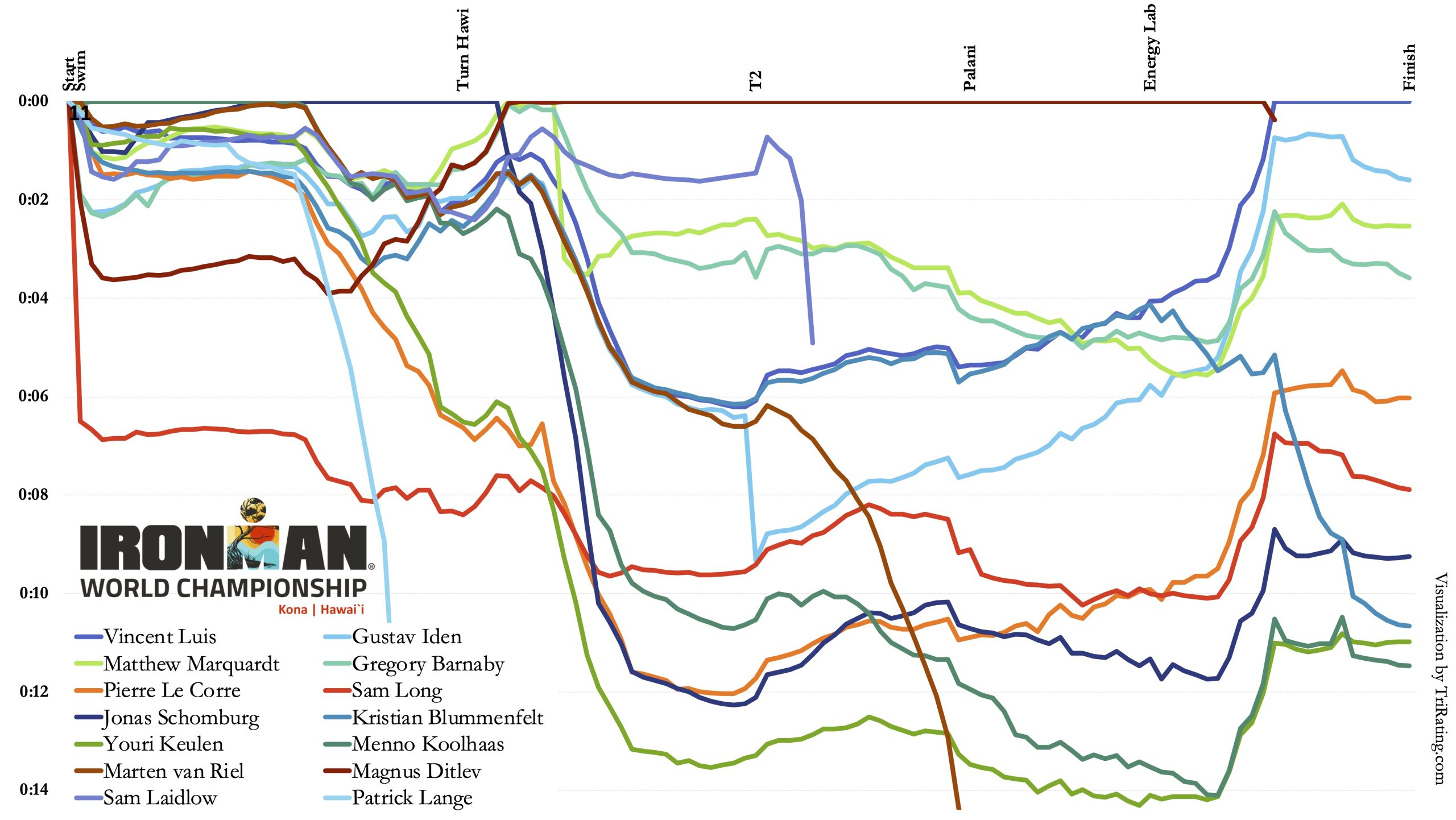
The race in short:
- Swim: Before the race there was much talk about a WhatsApp group of athletes who wanted to break up the race with a fast swim. But in the choppy ocean the field stayed unusually close: 24 athletes, almost half the field, came out within 31 seconds of T1 leader Marten, who swam 48:17. Only a few contenders fell out of the group. Gustav and Gregory lost contact late in the swim and came out almost two minutes behind, just ahead of Magnus. Sam Long had the slowest swim of the eventual Top 10 finishers: he was 6:30 behind. Menno was first onto the bike after a T1 of 1:57, the fastest of the day.
- Bike to Hawi: Menno led through town until Jonas caught him after about 20 km. Shortly after, Jonas pulled away from the field, building a lead of about one and a half minutes between about 50 and 80 km. Behind him, a chase group formed around Matthew, Sam Laidlow, Marten and Menno. Gregory and Vincent bridged up to it around Waikoloa. Patrick was cramping from early on the Queen K, lost contact to his group after about 25 km and stopped at Hawi. After a slower T1, Magnus left T1 3:18 down but with his steady pace started to make up time from about 50 km into the bike. At the turnaround Jonas still had the lead, but only by 53 seconds over Matthew, followed by a loose chase group of the main contenders between 1:20 and 2:40. On the bike, Sam Long didn’t lose much more time: in Hawi he was 8:24 behind the leader.
- Bike back to town: Jonas struggled with cramps after Hawi and fell back. After the descent, Matthew, Magnus and Gregory were together at the front. Just after Kawaihae, Matthew received a three-minute penalty following an overtaking maneuver with Gregory and Magnus. After 135 km, Magnus also rode away from Gregory, and Sam Laidlow caught and passed Gregory to move into second position. Further back, Vincent had to drop back into the group with Kristian, Gustav and Marten. Gustav also received a three-minute penalty, and Gregory lost his aero bottle and got a one-minute penalty for littering. At T2 Magnus led Sam Laidlow by 1:27. Matthew was 2:23 back and Gregory 3:34. Kristian, Vincent and Marten came in about six minutes down. After serving his penalty right before T2, Gustav was 9:19 back, closely followed by Sam Long (9:25).
- Run to the Energy Lab: Sam Laidlow had to stop early in the run with a numb leg caused by restricted blood flow on the bike that didn’t get any better on the run. Magnus felt “incredible” and extended his lead to about 4:30 by halfway. Behind him, Matthew, Kristian, Vincent and Gregory swapped places on the Queen K without closing the gap to Magnus. Gustav was the fastest runner on the course but still about two minutes behind the chasers. Marten ran into problems after Ali’i Drive, while others such as Jonas and Sam Long ran well but were too far back in T2 to contend for the podium.
- The Energy Lab: Vincent and Kristian ran into the Energy Lab together, but on the descent into the headwind Vincent started to pull away, and he was soon more than a minute clear of the other chasers. Behind him, Gustav kept running well and moved through the group: he passed Matthew at the turn into the Energy Lab, then a fading Kristian, who eventually dropped to eighth, and Gregory before the exit. After the Energy Lab turnaround, Magnus began to lose control of his body, and by the exit he could barely run in a straight line. His lead over Vincent fell by two minutes within about 3 km, to only 1:10 at 33 km. Vincent passed him at about 34 km, and Magnus stopped by the roadside shortly afterwards.
- Finish: When Magnus had to stop, Gustav moved into second, only 44 seconds behind Vincent at 34 km. For the next five kilometers he couldn’t get any closer; 39 seconds at 37 km was the smallest gap. Vincent used his last “match” on the Palani descent, winning by 1:36. Gustav finished second with the fastest marathon of the day (2:36:58), Matthew third (2:32 back) and Gregory fourth (3:35). Pierre ran the third-fastest marathon and came through from 17th at T2 to fifth.
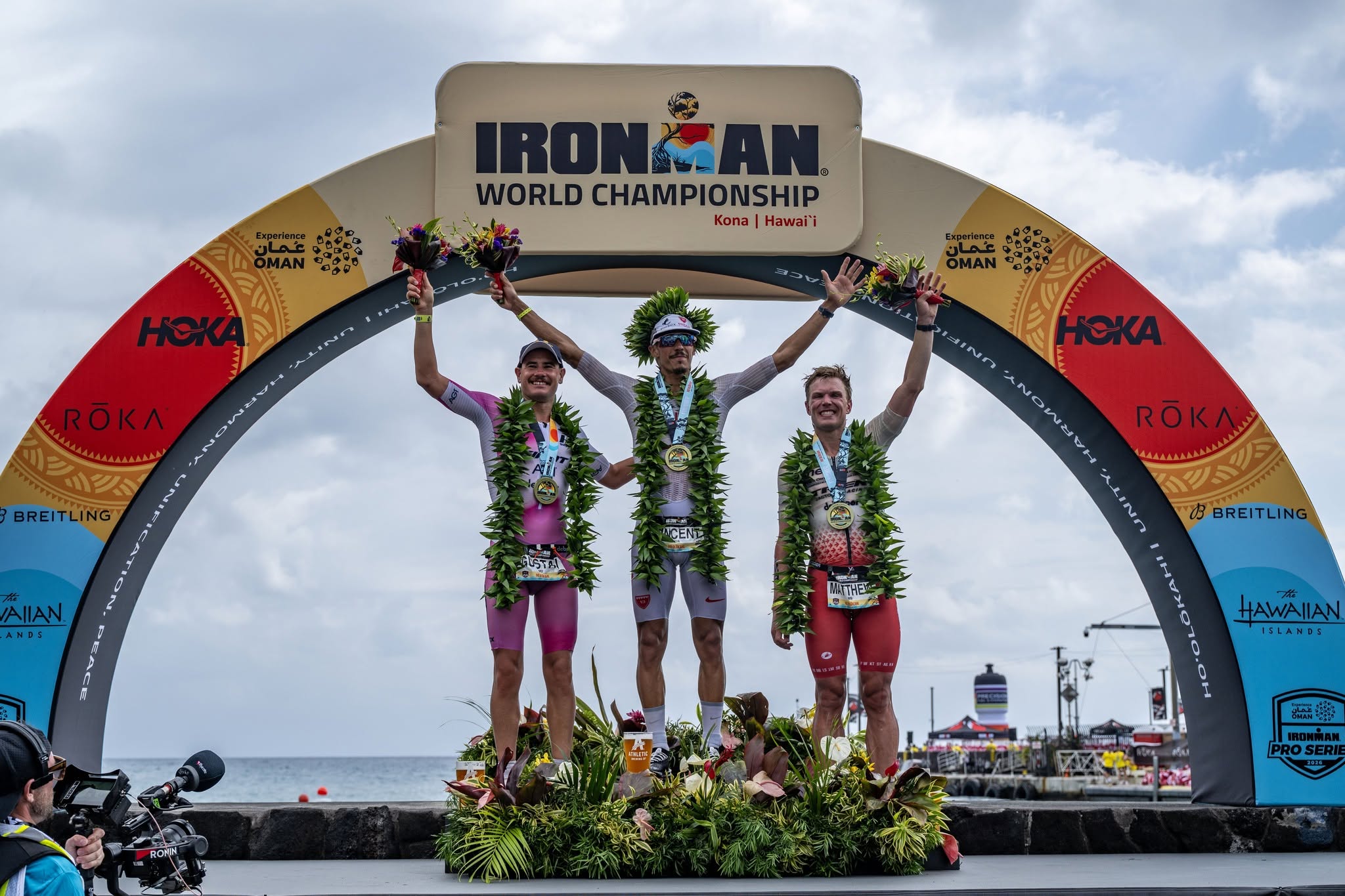
All Photo Credits: Ironman (except where noted)
A few notable data points:
- Slower conditions. Rain overnight and in the morning, high humidity once the sun came out, and plenty of wind on the bike. Based on my analysis of the actual finishing times this year, conditions were the slowest in recent years: the overall adjustment was −13:18 (negative means slower), more than 16 minutes slower than the pre-race course rating of +3:04, and much slower than the faster Kona conditions of 2023 (+9:52, women’s race) and 2024 (+6:14, men’s race). The swim was slower than expected (−3:34 vs. a rating of −1:16), as were the bike (−1:04 vs. +8:20) and the run (−8:41 vs. −4:00).
- No role for the Champions. The defending champion didn’t start: Casper Stornes crashed in the Kona winds two weeks before the race, broke his collarbone and had to withdraw. Patrick Lange, the most recent Kona winner and also champion in 2017 and 2018, was cramping early on the bike and stopped at Hawi.
- Another debut winner, and in his last race. Vincent won on his first Kona start, in his third full Ironman and the last race of his career. Before that he had never been on an Ironman podium. In recent years, debut World Champions have become quite common: since 2022, Kristian Blummenfelt (St. George 2022), Gustav Iden (Kona 2022) and Casper Stornes (Nice 2025) also won the men’s title at their first attempt, as did Chelsea Sodaro (Kona 2022) and Solveig Loevseth (Kona 2025) in the women’s race.
- Three penalties in the top four. Gustav and Matthew each got a blue card (three minutes for drafting infringements), Gregory a yellow card (one minute for unintentional littering). Simply subtracting those minutes from their finishing times doesn’t work, though. Gustav and Matthew both noted that standing still in the penalty tent, with time to drink, eat and cool down, isn’t a full three-minute loss in Kona. And their penalties didn’t come out of nowhere: in the referee’s view, they broke a rule. Without the incidents, the race on the way back would have unfolded differently, and so would everything after it.
- A steady day can be enough for the Top 10. Pierre went from 17th after the bike to 5th, Jonas from 19th to 7th and Youri from 20th to 9th. That isn’t unusual: in every men’s Kona race since 2010, at least one athlete made the Top 10 from outside the top 15 at the start of the run, two on average. The podium is a slightly different story. Only twice in 13 races did someone get to third from that far back: Patrick Lange in 2016 and David McNamee in 2018, both from outside the Top 20, both with exceptional marathons.
- Not more DNFs, but costly ones. With 11 of 52 starters not finishing (21.2%), the DNF rate matched the long-term average of World Championships since 2003 (22.0%). But two of them came at the very front: Magnus and Sam Laidlow came off the bike first and second, and neither made it to the finish, the first time this has happened in a men’s long-distance race. A year earlier, the women’s race had seen the same: Lucy Charles-Barclay and Taylor Knibb led into T2, and both dropped out on the run.
World Champion: Vincent Luis
Vincent had announced Kona as the last race of his Pro career. He had never stood on an Ironman podium. He finished it as World Champion, after a race he summed up in two words his coach Glenn Poleunis had given him: “Be patient.” The plan seemed simple. Stay as close to the front as possible on the bike, and keep two “matches” for the marathon: one for the Energy Lab and one for the last four kilometers.
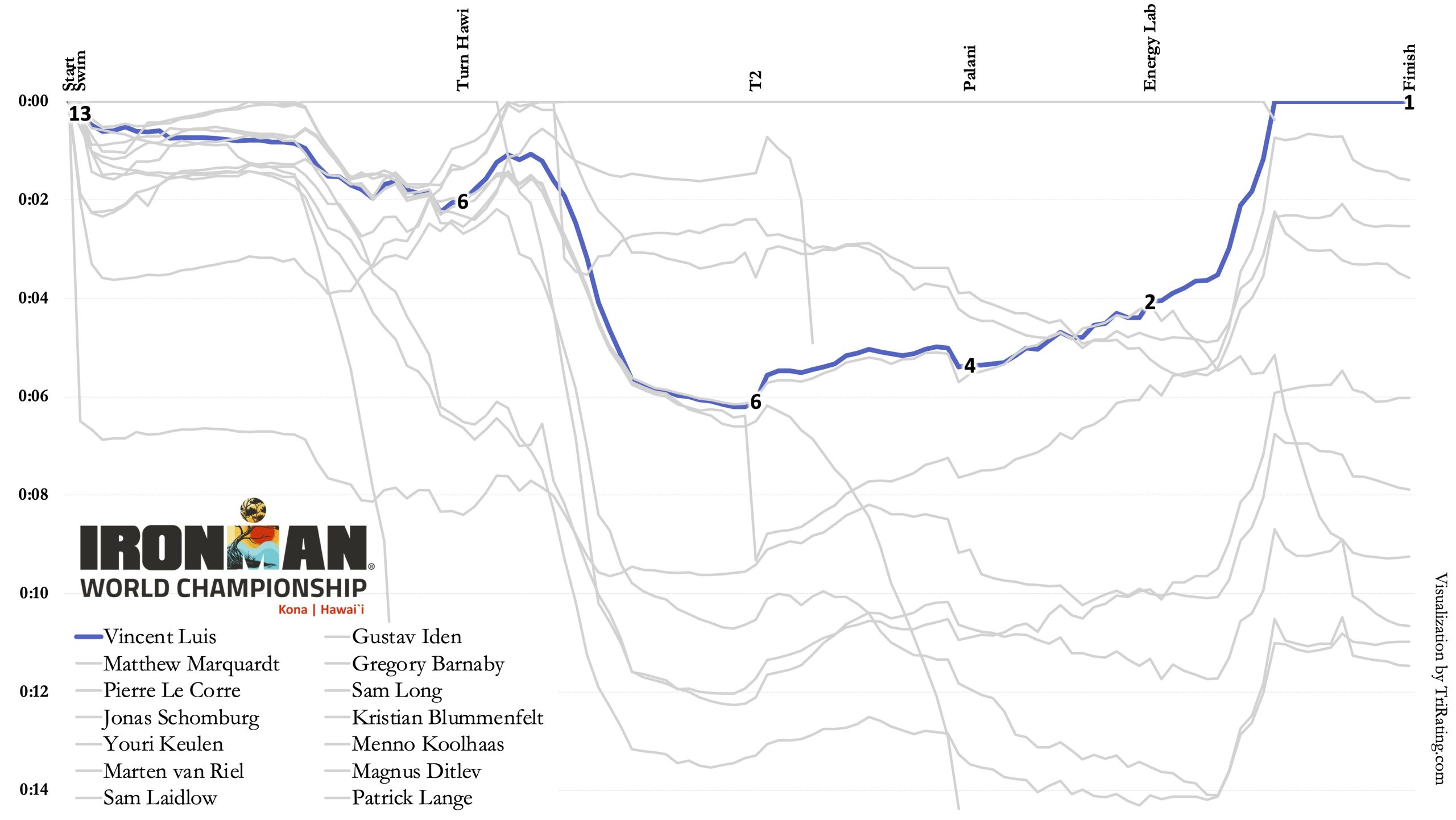
The choppy swim was quite slow and Vincent stayed out of trouble, coming out 14 seconds behind his training partner Marten. But seeing Patrick next to him at the exit was not what he wanted: “That’s one card gone.” The swim hadn’t opened any gaps on his rivals.
Wary of penalties in the early chaos, he let others go in the first kilometers of the bike leg and was only around tenth as he reached the Queen K. He didn’t worry: the Norwegians and Magnus were still behind him. When Gregory came past, Vincent went with him. The two shared the work and bridged up to the front group before the climb to Hawi. At the turn he was sixth, two minutes behind Jonas and forty seconds to a minute behind Matthew, Magnus and Gregory.
His former coach Joel Filliol had once told him that Kona has two key moments, the turn at Hawi and the Energy Lab. Vincent tried to make the most of the first one. Right after the turnaround he went after Matthew, Magnus and Gregory. For a couple of kilometers he was the fastest rider on the course, but the three matched his pace on the rest of the descent and kept their lead. Vincent passed a struggling Jonas, but when Sam Laidlow came past him before Kawaihae, he decided it was time to settle. With more than 60 km to go, in what he called “no man’s land,” he rode at a controlled effort and let the group with Kristian, Gustav and Marten ride up to him. “It took him forever to catch me,” he said of Kristian, and asked him “what took you so long?” For the final 20 km, he rode carefully on Kristian’s wheel, keeping a 20 m gap so that no one could slot in. He had expected to lose another two minutes to the front in the second half of the bike, reaching T2 maybe four minutes behind. But at T2 he was 6:05 behind Magnus, still together with Kristian.
On the run, Vincent tried to read Kristian from the start. He ran a few seconds ahead of Kristian at first, then waited for him on the Queen K after the out-and-back on Ali’i Drive. From about 16 km they ran side by side, but they weren’t catching Magnus: from 5:34 at the start of the run, the gap only came down to 4:47 by halfway. When Vincent remarked that Magnus wasn’t giving them much, Kristian just answered “yes.” “That’s not the Kristian I know,” Vincent thought. “He would have said: let’s go get him.” In the Energy Lab, in a headwind, Kristian was reluctant to share the pace-making. That was the second hint for Vincent. His training partners had warned him that attacking Kristian only makes him stronger, but Vincent used his first match anyway. He had spent twelve weeks at altitude in Font-Romeu with a drawer of chocolate he wasn’t allowed to touch, and he thought: “You did not do that to get dropped here.” Within three kilometers he put a minute into Kristian.
It was the second of Filliol’s key moments, and Vincent would still leave the Energy Lab with something left in the tank. Magnus was still about three minutes ahead, and Vincent was almost ready to settle for second. Then Glenn told him Gustav was only 1:40 behind and had taken 20 seconds out of him in the last three kilometers. “Then maybe today is third,” Vincent thought. “That’s still good.”
Back on the Queen K, the news from the front changed. On the way into the Energy Lab someone had told Vincent that Magnus had a bad habit of walking there. Now he was hearing that Magnus wasn’t looking good. He could see the helicopter and the motorbikes coming closer, and as Magnus began walking the aid stations, the gap fell quickly. He passed a wobbling Magnus at about 34 km. “Magnus, I really like you, but I think today’s the day.” It was heartbreaking, Vincent said later. He had trained with Magnus in Sierra Nevada over the summer and called him “genuinely the nicest person on the planet.”
Now it was about holding off Gustav. Vincent switched his watch to a heart-rate-only screen and stopped looking at his pace. His own rule was simple: if he still had 25 seconds with five kilometers to go, he would be fine. From 34 km Gustav stayed about 40 seconds behind; the closest he got was 39 seconds at 37 km. Vincent read it as Gustav either saving a sprint or “pushing as hard as me.” At the top of the last climb before Palani, he heard he still had 40 seconds, then used his last match on the descent: “Lights out and away we go.” The gap grew to over a minute, and he won by 1:36 after a 2:38:36 marathon.
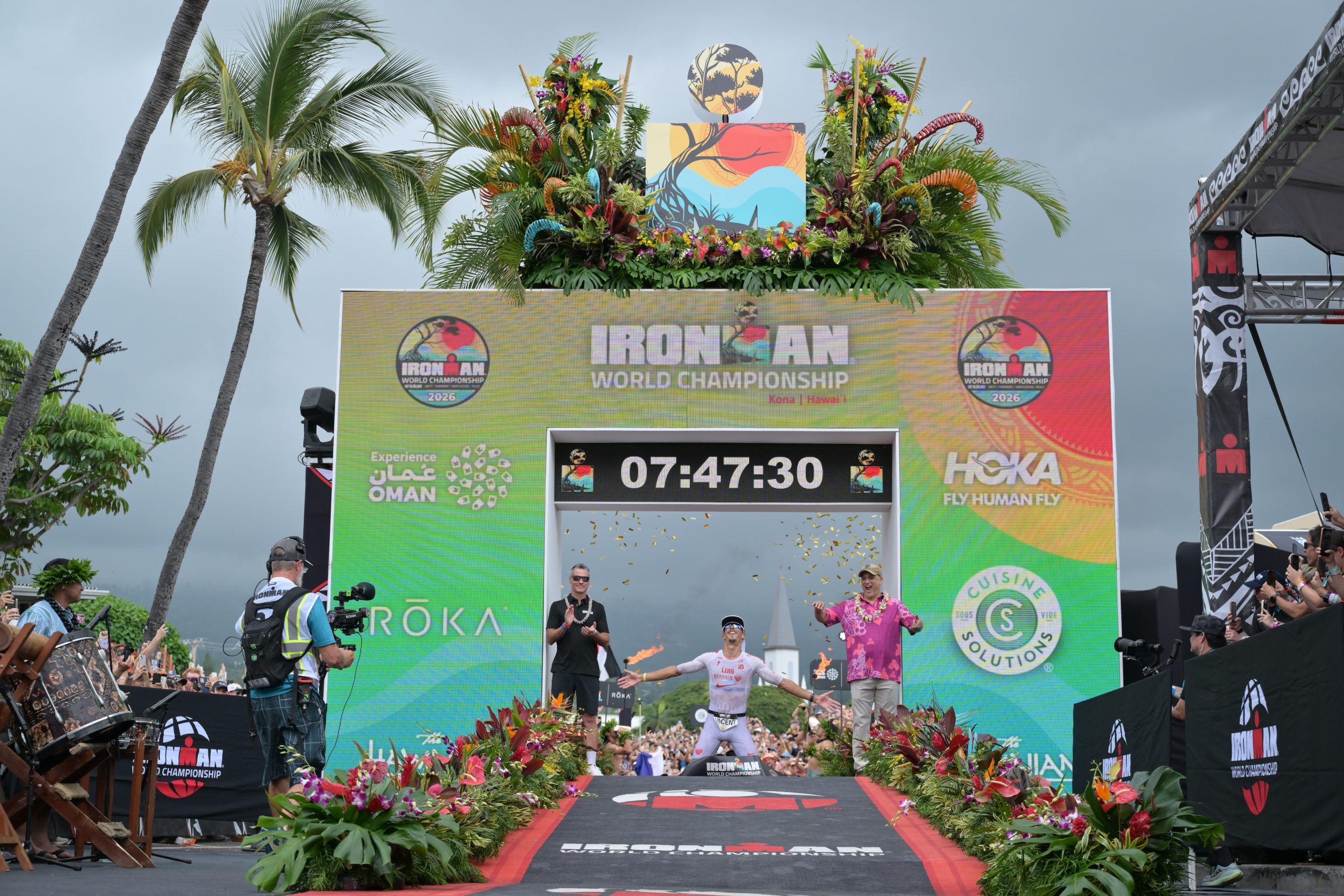
Vincent was quick to acknowledge the misfortunes of others: “Gustav’s penalty, Matthew’s penalty, Magnus blowing up. It’s not only me that did perform.” He has no plans to reconsider his retirement. The first thing he wants to do with his prize money is buy lasting gifts for his coach Glenn, his training partners Marten and Youri and the rest of his team. For the next two years he plans to support his partner, Georgia Taylor-Brown, in her racing.
Second: Gustav Iden
Gustav came back to Kona with an up-and-down record: He won the 2022 World Championship with a run course record, but two years later his race ended at the side of the Queen K. This year, Gustav almost repeated his 2022 win.
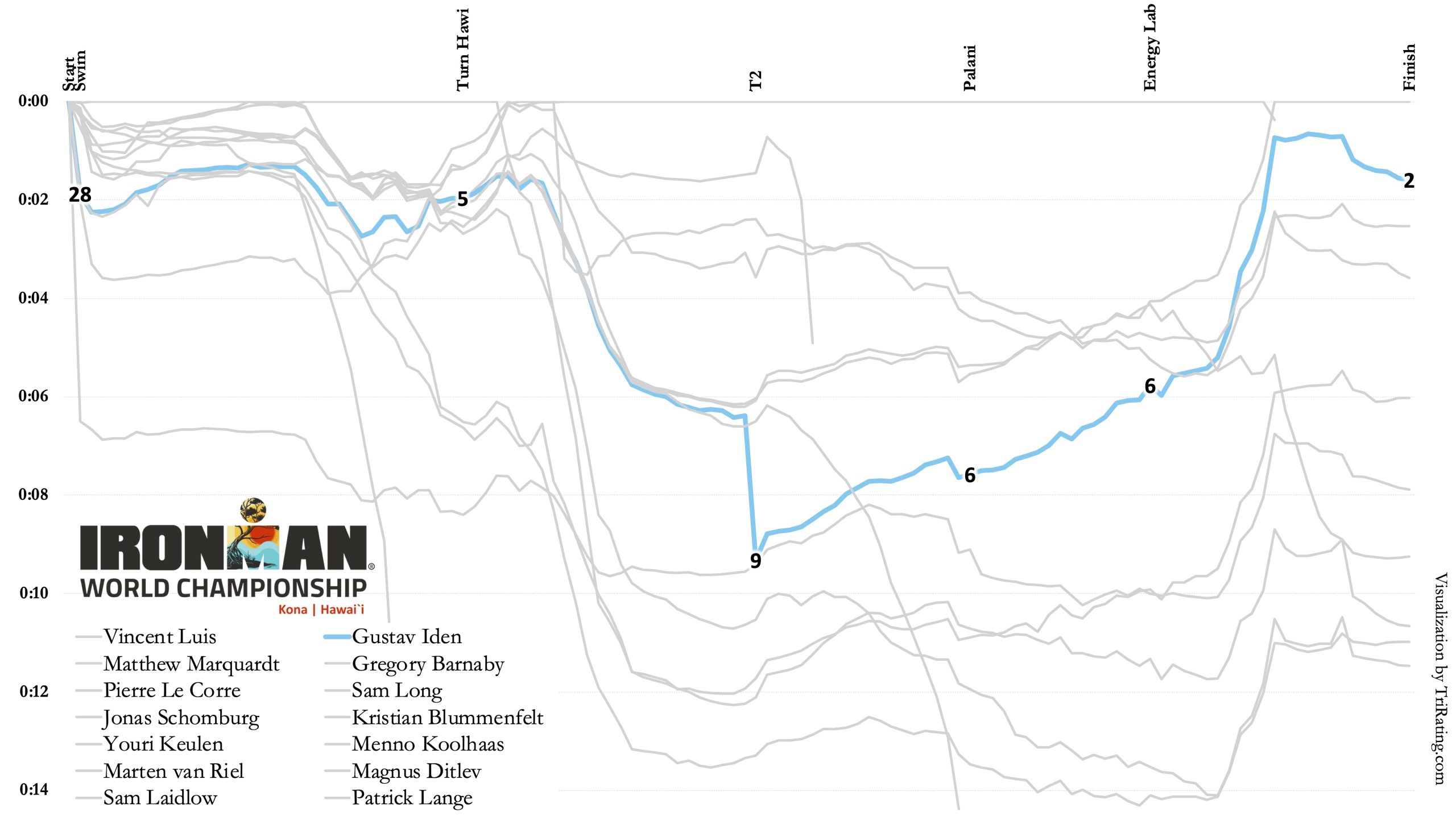
After losing more than a minute in the swim at 70.3 Worlds in Nice, Gustav wanted to swim more aggressively in Kona. He was able to stay on Kristian’s feet dangling at the end of the lead group until about 1,500 m from the finish. When Kristian surged to close a gap, Gustav had to let him go and then took the last part a bit easier. He came out 1:53 behind Marten and 1:22 behind Kristian but still felt good. He then went hard from the start of the bike, and after the section through town he had already caught back up to Kristian.
The rest of the bike was more of a struggle for Gustav. He reckoned the wind was around 75% headwind over the day, and on the way back he couldn’t relax in the gusts. Tension in his left foot kept him from pushing the power he wanted, and on the descent from Hawi he had to let Vincent go. Marten and Kristian caught Gustav, and the three stayed together. About 25 km from T2, Marten passed and slotted in legally between Gustav and Kristian. Gustav had to drop back to the legal distance and was too slow doing it. “I was maybe like a rookie, and I thought the rule was only I have to show rearward motion.” The referee had her timer running, and the rule allows only 25 seconds. The pass came at the start of a small climb, where dropping back almost means hitting the brakes. Arguing with the referee changed nothing.
The penalty hit him hard. Gustav gave up any thought of winning and simply stayed with Kristian without pushing. A few kilometers later they caught up with Vincent. Gustav served the penalty just before T2, using the time to stretch, drink and get ready for the run. In his view a three-minute penalty doesn’t cost three full minutes in Kona. Still, he started the run 8:47 behind Magnus and more than three minutes behind Kristian, who had outrun him in their two big training sessions on the island. Gustav didn’t think he could close that gap. He wrote off the win and didn’t think about the podium. Coming out of the penalty box, he was simply glad to see Sam Long come round the corner: at least he wouldn’t have to run the marathon alone.
When Gustav was ready to leave T2, Sam was still tying his shoes, and after three minutes in the penalty box, waiting for him “would be like waving the white flag.” So Gustav went alone, aiming for an average of 3:40 per kilometer. He was the fastest man on the course from the start: 34:46 for the first 9.7 km, compared with 35:33 for Vincent and 36:00 for Magnus. Over the hills between 10 and 16 km the gap to Magnus stayed almost unchanged. Gustav expected a Danish victory and hoped to run into the top five.
Gustav kept running well. At the turn into the Energy Lab he caught Matthew, then passed Kristian, the man he had thought he couldn’t catch, and Gregory before the exit. He was now third. Ahead of him, Vincent had broken away from Kristian, and Magnus, still more than three minutes up, was slowing. Coming out of the Energy Lab, Gustav was gaining on both and began to believe he could win even from so far back. He saw Magnus struggling at an aid station and wrote him off even before passing him shortly after 34 km, just after Vincent had taken the lead. By then he had cut his deficit to Vincent from 1:41 in the Energy Lab to 44 seconds, and from then on he was only thinking about catching him.
On the Queen K, where he had run down Sam Laidlow in 2022, he felt almost as good as then. With about five kilometers to go and 40 seconds to make up, Gustav still believed it was possible. He didn’t think about protecting second place and kept attacking. But in the last kilometers he started to fade, and on the Palani descent Vincent pulled away for good. “We both died,” Gustav said, “but he died a little bit less than me.”
He finished second, 1:36 behind Vincent, with the fastest marathon of the day. At 2:36:58 it was only 43 seconds slower than his 2022 run, which is still the run course record. The timing mats were placed differently in 2022, which makes the splits hard to compare. But it looks as if he ran a very similar pace for the first 36 kilometers and then lost most of the difference in the last six. Even matching his record time would have left him almost a minute short of Vincent.
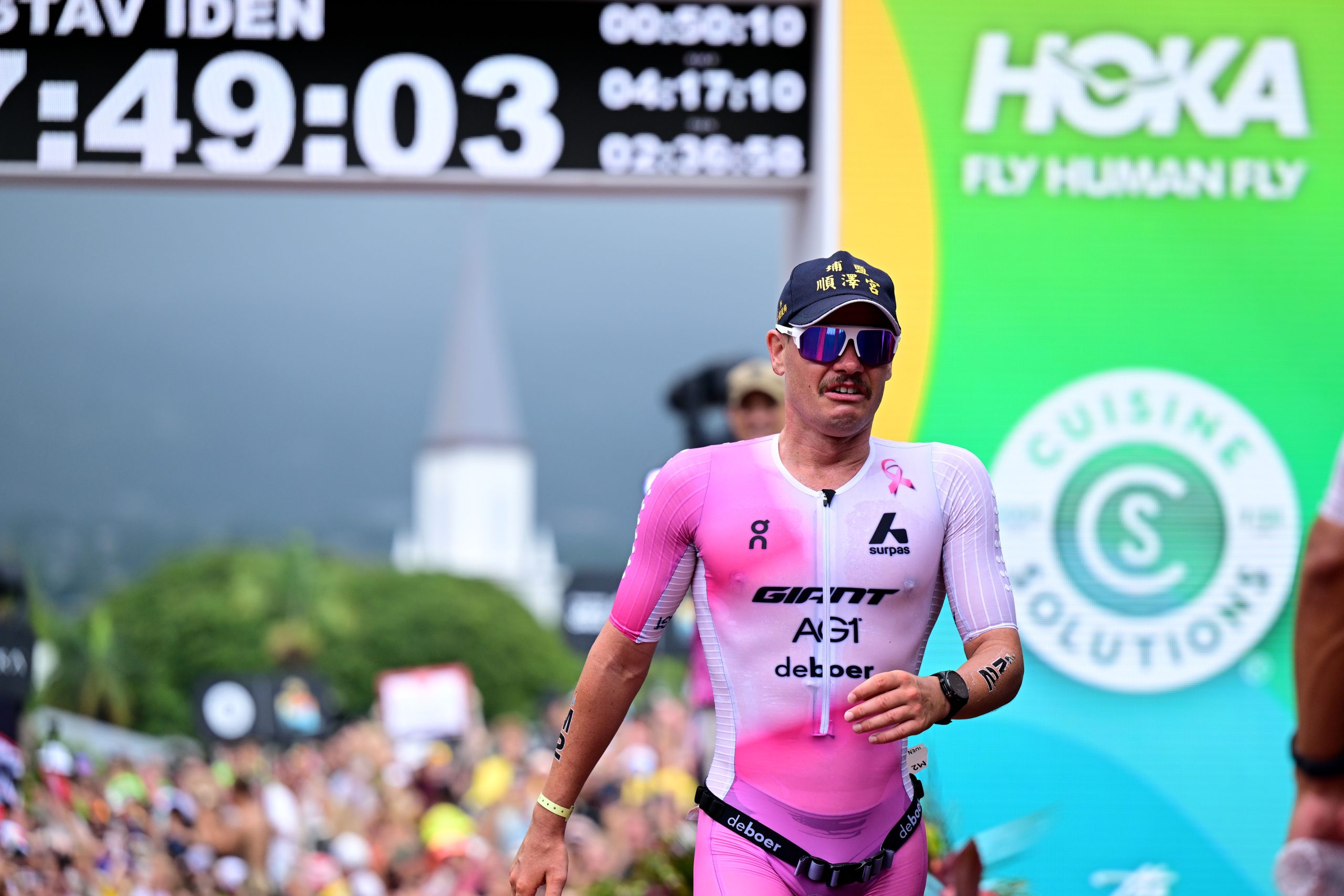
The emotions he had held back all day came out at the finish line. He had dedicated the race to his late mother and raced in a pink suit designed in her memory, on a bike that, together with the suit, was the top prize in his fundraiser for the Norwegian Cancer Society. By the time the campaign closed a few days after the race, it had raised more than one million Norwegian kroner (around $100,000). “I was managing to stay kind of professional during the race,” he said, “but just when I crossed the finish line, everything just let loose.” There was also an unexpected bonus: second place in Kona moved him from eighth place to first in the Ironman Pro Series to win $200,000, something he hadn’t thought of at all beforehand.
Third: Matthew Marquardt
After years of training mostly alone, Matthew had joined a swim group this season, because he knew a strong swim would be crucial in Kona. It paid off. He came out of the water third, only eight seconds behind Marten, relaxed and with his heart rate under control. That set the theme of his day: managing his core temperature from the start.
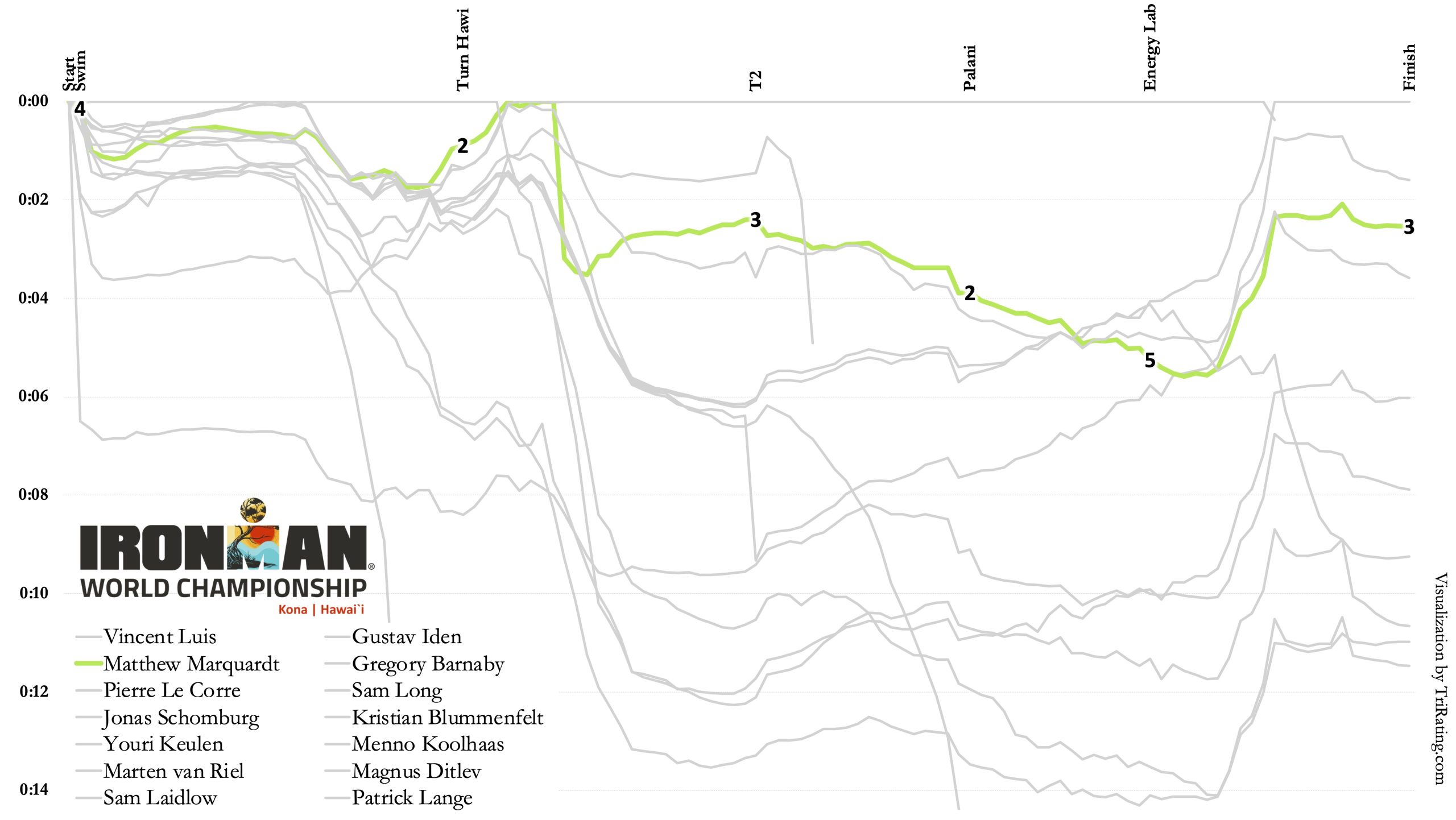
On the bike he rode with the front group out to Hawi and was happy with his power for the heart rate he was seeing. According to Vincent, Matthew and Sam Laidlow were attacking each other on the way out. At the turnaround he was second on the road, 53 seconds behind Jonas. On the descent from Hawi, Matthew passed Jonas, and from there he shared the front of the race with Magnus and Gregory. He had expected more riders to catch up, but the wind and heat broke the race apart. For once, he said, the bike really mattered in Kona.
Then came the penalty. On a climb after Kawaihae, Gregory passed Matthew and then Magnus. Matthew, still inside Gregory’s draft zone, followed him past Magnus and only then dropped back. Under the rules he should have dropped out of Gregory’s zone first, and the referee gave him a three-minute penalty. Matthew explained his view on the spot, but the referee stuck to his decision. “I think other refs truthfully would not have called it,” Matthew said later.
He didn’t let it ruin his race. The situation at the front had blown open, so he knew three minutes wouldn’t cost him many places. He pushed hard for the remaining 20 minutes to the penalty tent, used the stop to drink and eat, and quickly rode back up through the field. By T2 he had pulled back over a minute on Magnus, passed Gregory and reached the run in third place, 2:23 behind Magnus. Even with the penalty, his 4:11:28 was the second-fastest bike split among the finishers, only five seconds slower than Gregory’s.
His plan for the run was simple: run his own race until the exit of the Energy Lab, then race for places in the last 45 minutes. He took his time in T2, getting ice and started conservatively. When people told him he was only three minutes behind Magnus, he didn’t care: what would matter would be the gap two hours later. He wore cooling gloves and a bucket hat with an ice pocket on top.
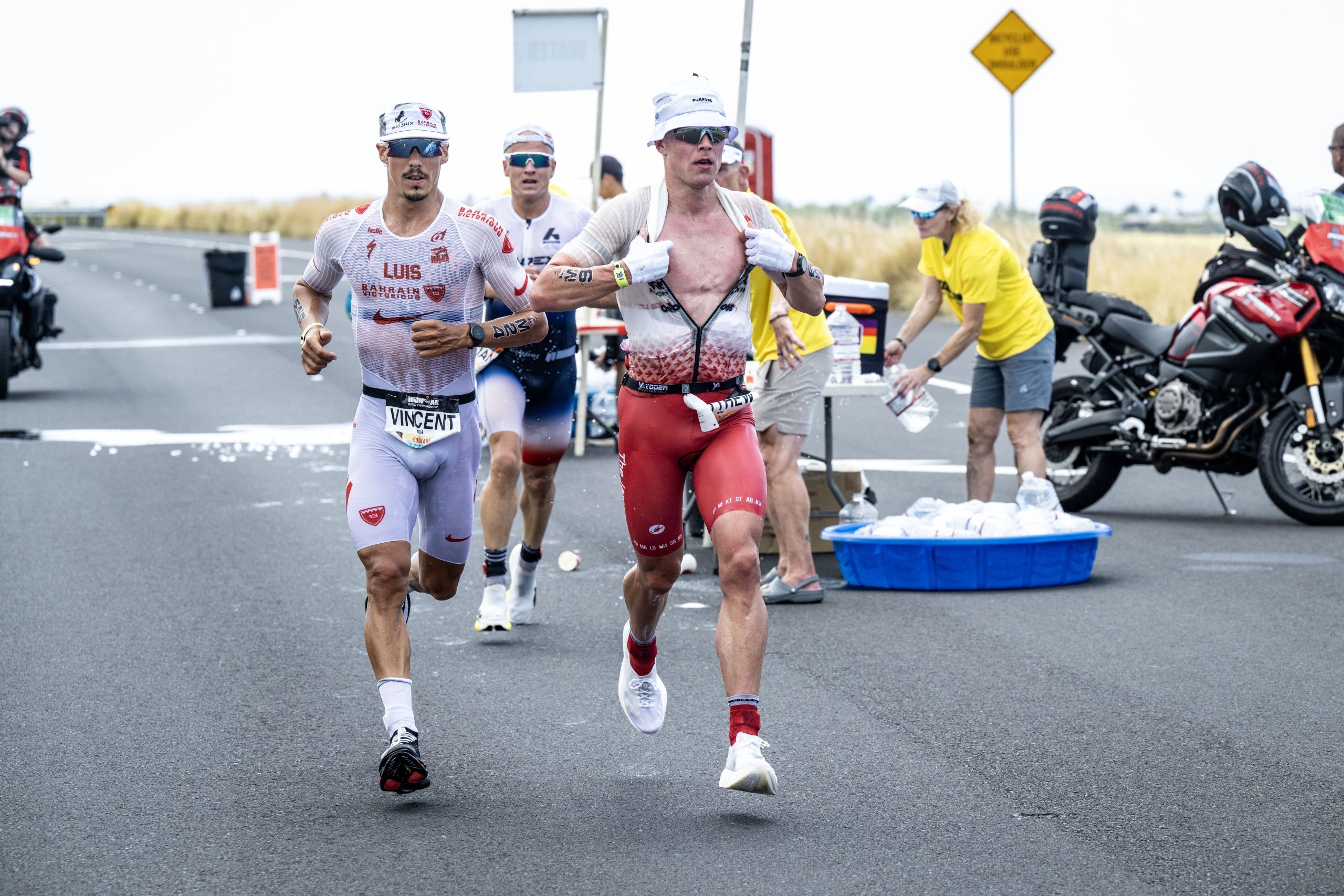
After Sam Laidlow stopped early on the run, Matthew was second until halfway. Then came his low point. Before the Energy Lab, Kristian, Vincent and Gregory passed him; in the Energy Lab, Gustav did too. For 20 minutes he was in a bad place, sixth on the road and wondering whether he would even make the Top 10. What changed after that, he can’t fully explain himself. Seeing Kristian fade certainly helped, and at some point he simply started feeling better again. He passed Kristian at 30 km. After trading places with Gregory several times, Matthew passed him for good at around 35 km, and when Magnus dropped out he was back in third. He wasn’t entirely surprised by how many men were paying the price late in the race. In his view, the overnight rain had given many a false sense of security, and they underestimated how humid it would be once the sun came out.
The last kilometers were about getting to the finish before the tank ran empty, with Gregory still close behind. Matthew crossed the line in third place, 2:32 behind Vincent and 56 seconds behind Gustav, after a 2:43:58 marathon. Gregory finished a minute later.
Matthew is a medical student, training to become an ear, nose and throat specialist. Four days after the race, he was due to present at an ENT conference in Los Angeles. In January he starts his surgical rotations, but he still plans three to five full-distance races next year and wants to secure his Kona slot early. His World Championship results read 11th, 15th, eighth and now third. Balancing both careers has always worked out somehow, and he has “no doubt that we’ll figure out a way to keep improving.”
Fourth: Gregory Barnaby
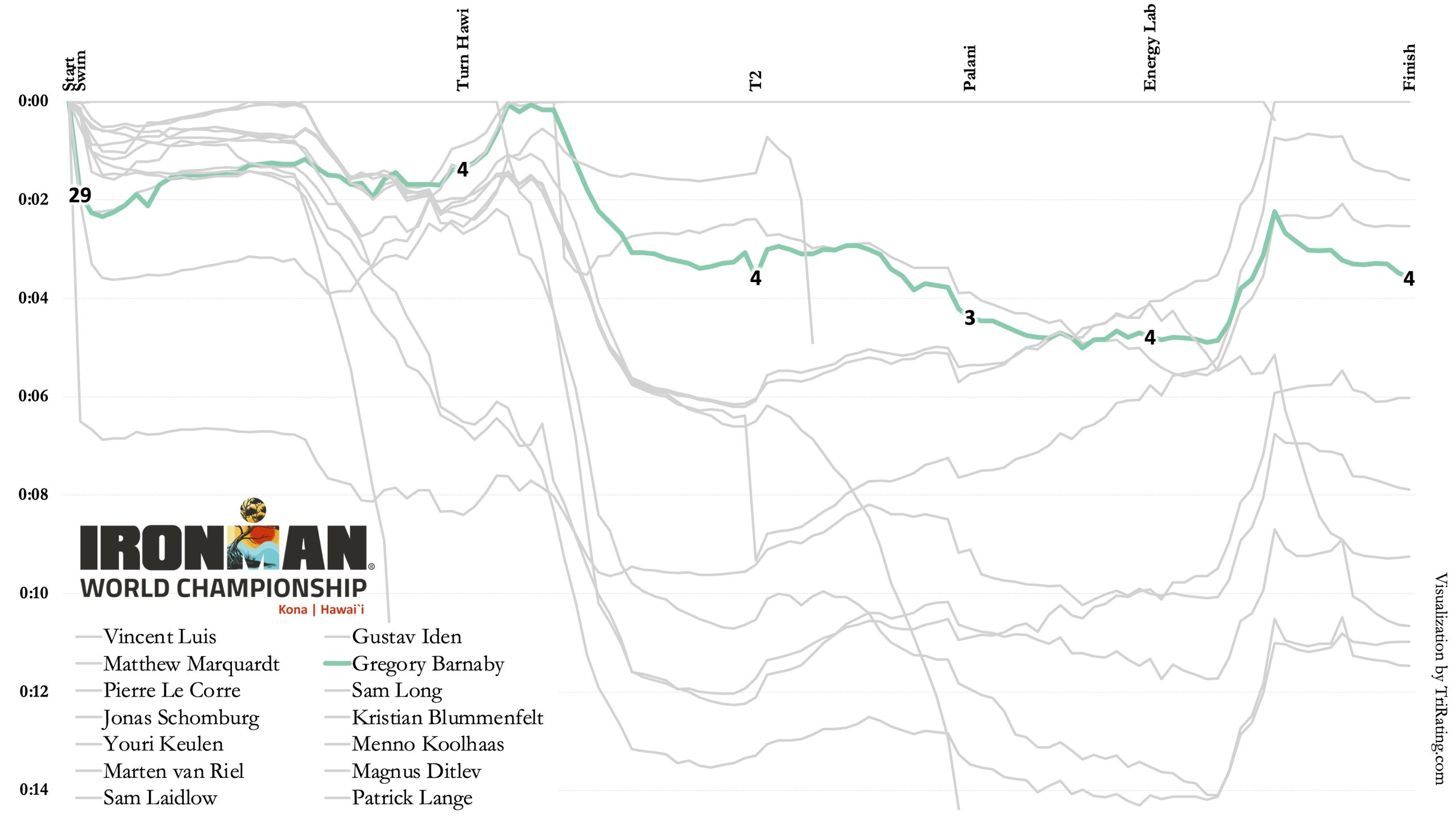
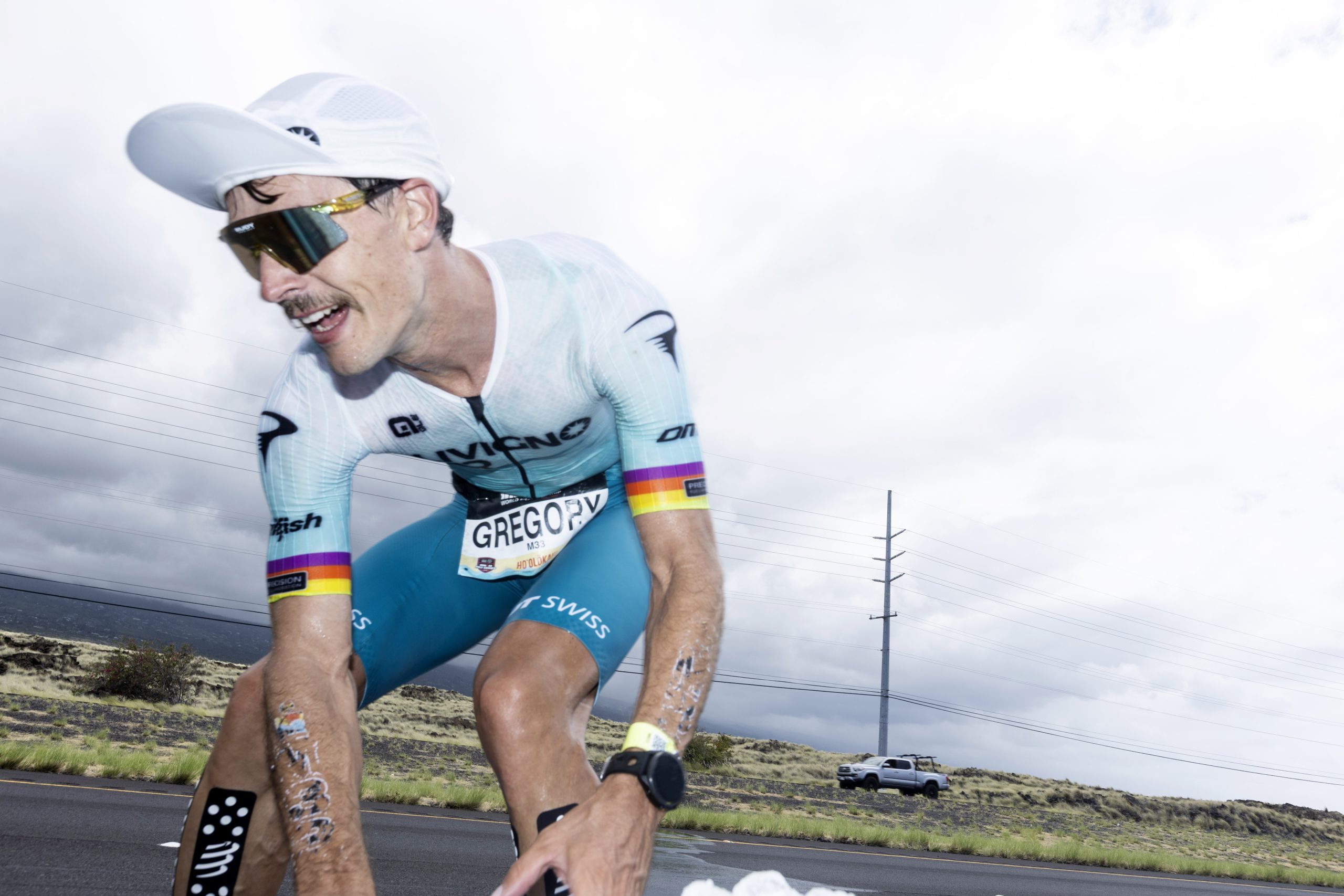
Gregory came out of the water with Gustav, 1:53 behind the leader, and the two of them “chased pretty hard” from the start of the bike. Gregory admits he went out too fast: after an hour he looked at his numbers and thought he was going to blow up. But he never followed a fixed plan anyway, he said: “I’m a racer.” On the Queen K he passed Vincent. The two shared the work and bridged to the front group before the climb to Hawi. Gregory reached the turnaround in fourth, 1:22 behind Jonas and only two seconds behind Magnus.
He called it probably his best bike ever in an Ironman. On the way back he stayed with the leaders: after 110 km he was part of the front trio with Matthew and Magnus. Just after Kawaihae, on the climb back up to the Queen K, he passed Matthew and Magnus, the incident that ended with a penalty for Matthew. Soon after, Magnus rode away from him, and Sam Laidlow came past. Gregory’s own bad luck came later. With about 30 km to go he hit a cateye, sending his aero bottle flying, with roughly 120 g of gel in it for the last part of the bike. That earned him a penalty for unintentional littering, which he called a “double penalty”: he had lost his fuel and still had to stop. He served it at the last penalty tent, just before T2. The last part into town was “a bit of a struggle.” Matthew, who had served his own penalty, passed him again, and Gregory started the run in fourth, 3:00 behind Magnus. Even with the one-minute stop, his bike split of 4:11:23 was the fastest of anyone who finished the race, five seconds quicker than Matthew. Only Magnus and Sam Laidlow, who both dropped out on the run, rode faster.
The run became a long duel with Matthew. When Sam Laidlow stopped early, Gregory moved up to third, and Matthew was never more than 30 seconds ahead. Around 20 km Vincent and Kristian came past, and soon after Gregory overtook Matthew. In the Energy Lab he looked like the stronger of the two: he passed Kristian and, at about 30 km, was third on the road behind Magnus and Vincent, about 40 seconds clear of Matthew. Then Gustav came through, and Matthew found his second wind. At around 35 km, just as Magnus dropped out, Matthew passed Gregory for good.
Gregory had dark patches on the run too, but he never let go completely. He knew Matthew from previous races: “I know he never gives up and we’re probably similar on that.” The gap grew to around a minute, and Gregory finished fourth, 3:35 behind Vincent and 1:03 behind Matthew, after a 2:44:44 marathon.
It was a strong end to a difficult season. Gregory had been ill in South Africa, crashed in Frankfurt and only secured his Kona slot at the last opportunity, in Kalmar in mid-August. Rather than costing him, that race gave him confidence, and a block at altitude in Livigno set him up for Kona. Sixth two years ago, fourth now: he is “getting closer to that podium,” and before the race he would have gladly accepted fourth.
Fifth: Pierre Le Corre
Pierre came to Kona for only his second Ironman, with a precise plan and a healthy respect for the island: “I know that it’s tough and everyone can blow up.” He would race on power and heart rate, and ignore everyone else.
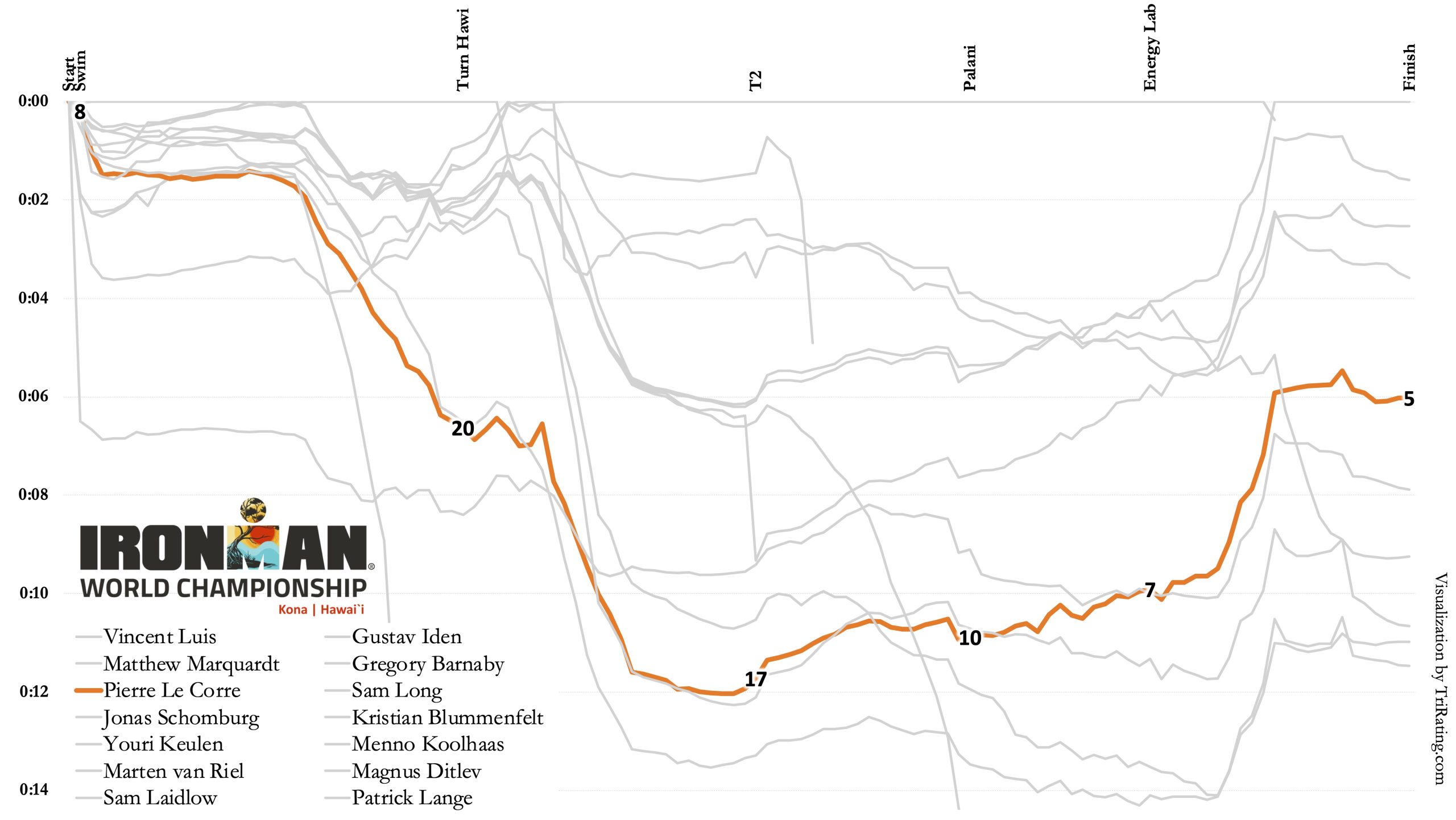
The swim put him right in the race: 48:29, firmly in the lead group only 12 seconds behind Marten. But the bike quickly became a struggle. Within the first 30 km he was cramping, which he put down to the humidity, and he had to stop several times. He soon lost touch with the front: 1:43 behind at 21 km, 3:06 at 42 km. On the climb to Hawi he rode with Youri in a loose group that never really worked together, and he reached the turnaround in 20th, 6:37 behind. Back in town he was 17th, 11:43 behind Magnus, after a bike split of 4:20:47.
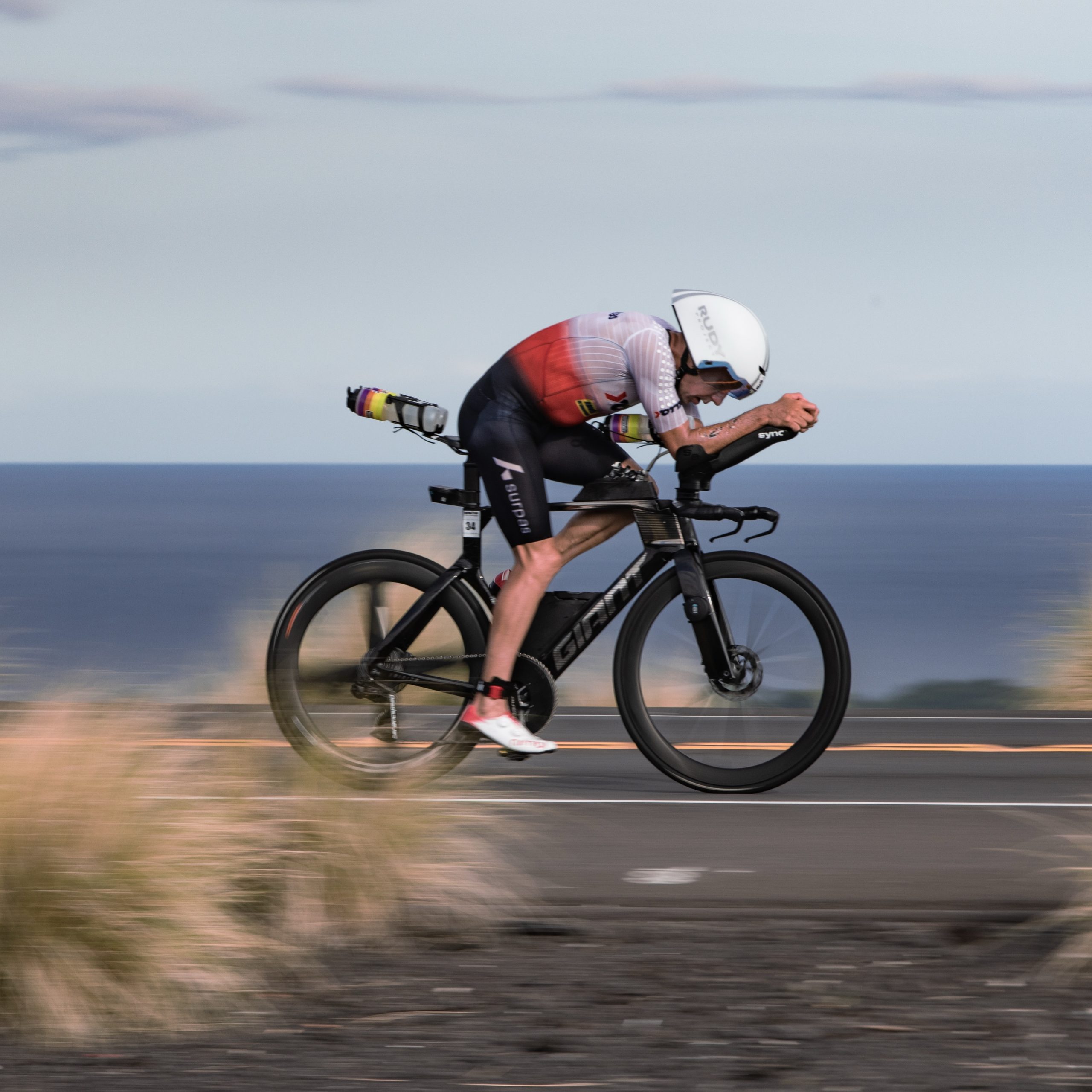
Photo Credits: Instagram @pierre.le.corre
Pierre saw an upside in it: riding alone and below his planned power kept his heart rate low, and that set him up for a good run. There he stuck to his heart rate and didn’t care what the others were doing. On Ali’i Drive he passed Menno and Marten, and by the time he climbed Palani he was already up to 10th. Out on the Queen K he took back the place he had lost to Jonas early on the run, and he reached the Energy Lab in eighth. At its entrance he passed Sam Long after a short back-and-forth. Shortly before 35 kilometers he caught Kristian, and with Magnus out of the race he was fifth.
His 2:38:50 marathon was the third-fastest of the day, only 14 seconds slower than Vincent’s. It took him from 17th at T2 to fifth, 6:02 behind the winner. “I wanted to do a Top 10,” he said, “and finishing fifth is great for me.”
The result meant more than the placing. After the 2024 season he had wanted to quit the sport. Even this year, after finishing second on his Ironman debut in New Zealand with a 2:36 marathon, training had often been a struggle: “I was not in the mood of trying to be on the podium.” He kept going on discipline when motivation was missing. “Maybe this race will fire me up for next year.”
Sixth: Sam Long
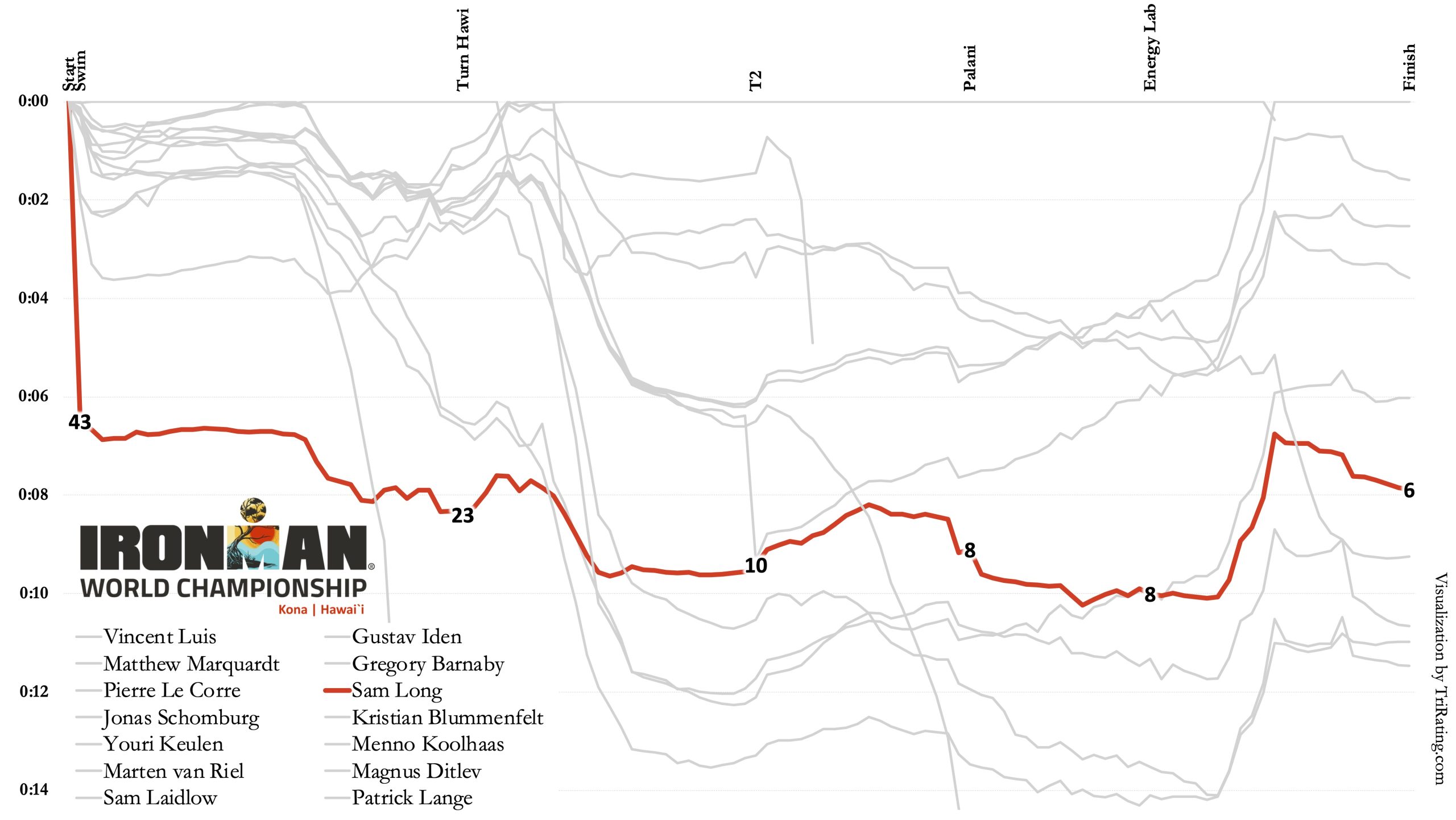
Sam Long was out of the water 6:30 behind Marten, after the slowest swim in the Top 10. The swim felt so easy that he spent most of it worried the lead woman would come past, until he noticed he was swimming alongside Matt Hanson, who is usually quicker in the water than him. That was encouraging. He had the fastest transition of his group and was ready to ride the whole bike alone. Only Cameron Wurf stayed with him. Cam did a little work early, but Sam led from the airport all the way to Waikoloa and did most of the work on the way back too.
He had built for this race on his own, writing his own plan. With physiologist Parker Spencer, he had worked on making his big power metabolically cheaper: lots of steady aerobic riding, fewer surges, and individual fueling targets. On a day when the wind and heat broke the race apart, his gap to the front barely moved on the bike leg: 6:40 at the start of the bike, 8:24 at Hawi, 9:25 at T2. Over the bike he gained almost three minutes on Vincent. Sam’s 4:12:50 bike split was the fifth-fastest among the finishers.
After Gustav had to stop in the penalty tent, he and Sam reached T2 close together. While Sam took some time tying his shoes in transition, Gustav ran off alone. Sam didn’t mind. His mantra for the run was to do his own race: “I really didn’t care where anyone was or what anyone was doing.”
The start of the run wasn’t easy. Sam was sweating so much on the bike that he drank far more than usual, and with it took in too many carbs. Early on the run he paid for it with cramps and could barely take in any carbs for the first hour. He still moved up steadily. Within the first 10 km he passed Jonas, Marten and Menno, and he held a steady pace while others started to fade. Pierre came past him in the Energy Lab, but on the Queen K Sam passed Kristian, and with Magnus out of the race he moved into sixth.
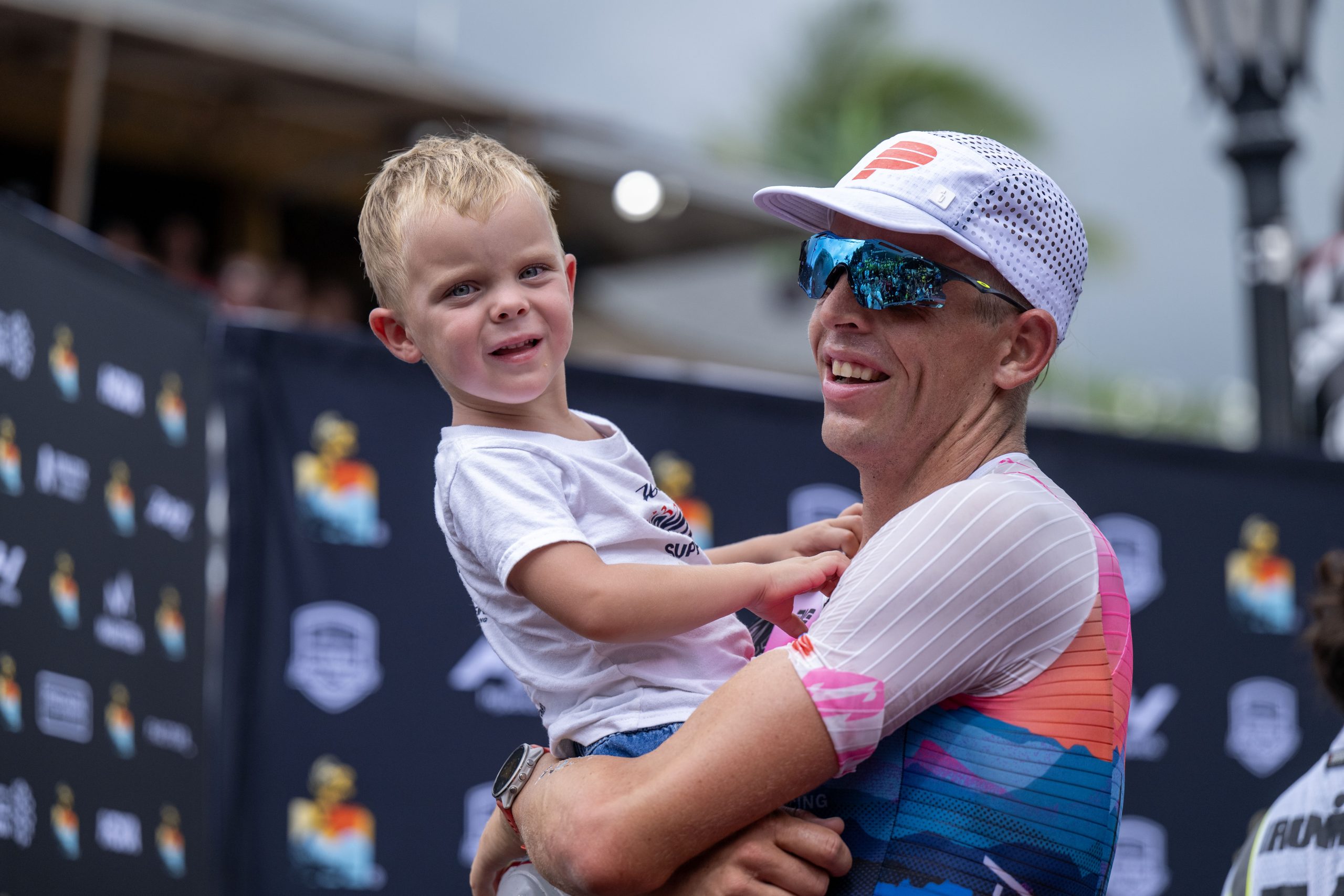
He finished there, 7:54 behind Vincent, with a 2:42:57 marathon and a negative split. By his own account it was his best Ironman, eleven years after his first Kona, when he finished sixth in his agegroup. With his family there, including his two young sons, it was a week he’ll “remember for the rest of my life.”
Seventh: Jonas Schomburg
After his World Championship debut with a sixth place in Nice last year, Jonas came to Kona for the first time as the winner of Ironman Kalmar. For the first three hours, he looked like the man to beat.
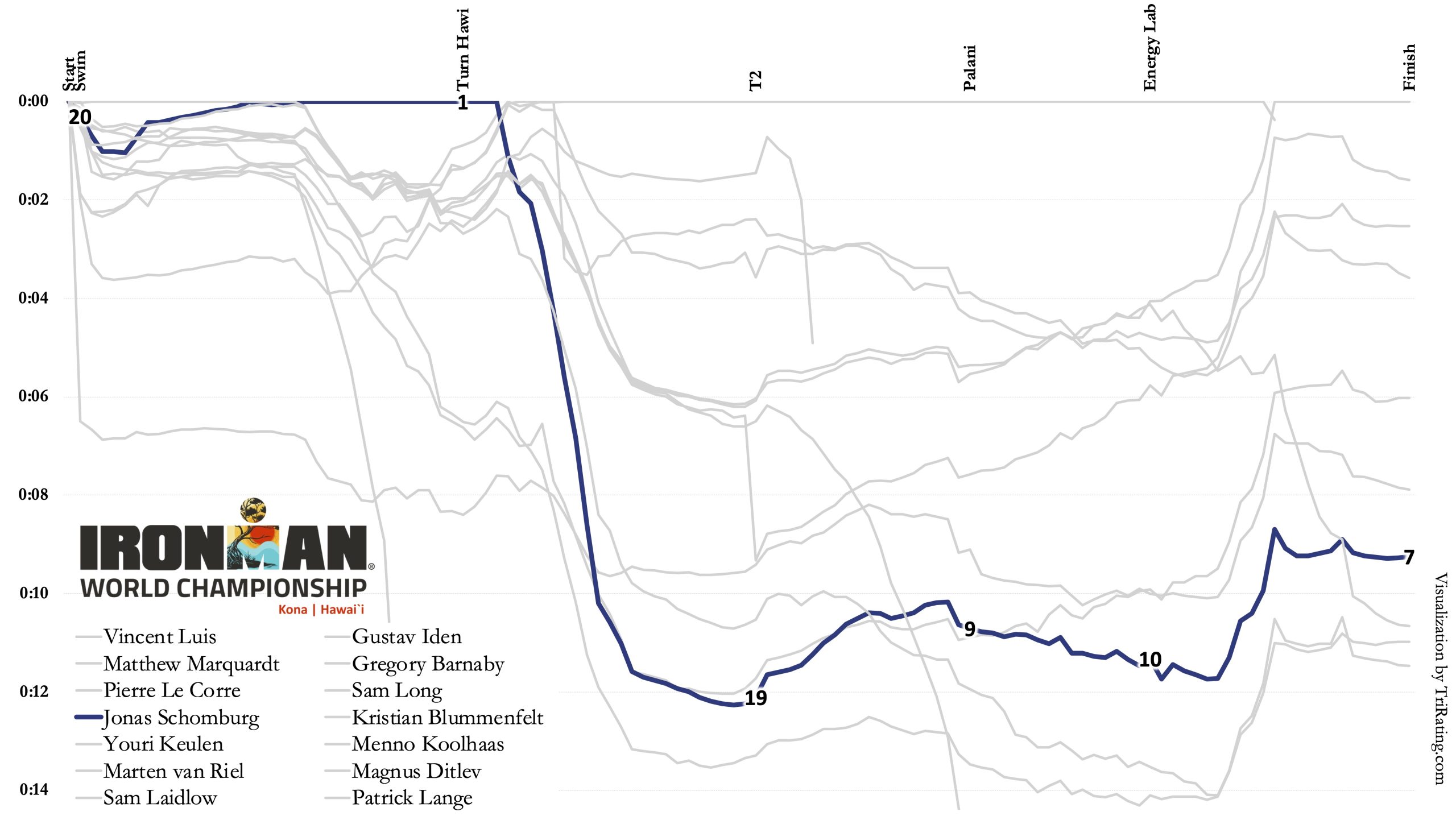
He swam 48:34 in the front group and then started the bike 41 seconds behind Menno. By 20 km he had caught Menno, and from about 30 km he started to pull away from the rest of the field. He felt in great form, “really fast,” and in control even on the wet roads. Riding alone at the front, he built a lead of about 1:41 to the chase group by 80 km. TV pictures showed the lightweight Jonas being pushed sideways by the gusts several times on the climb to Hawi, but he didn’t feel the wind was a big factor.
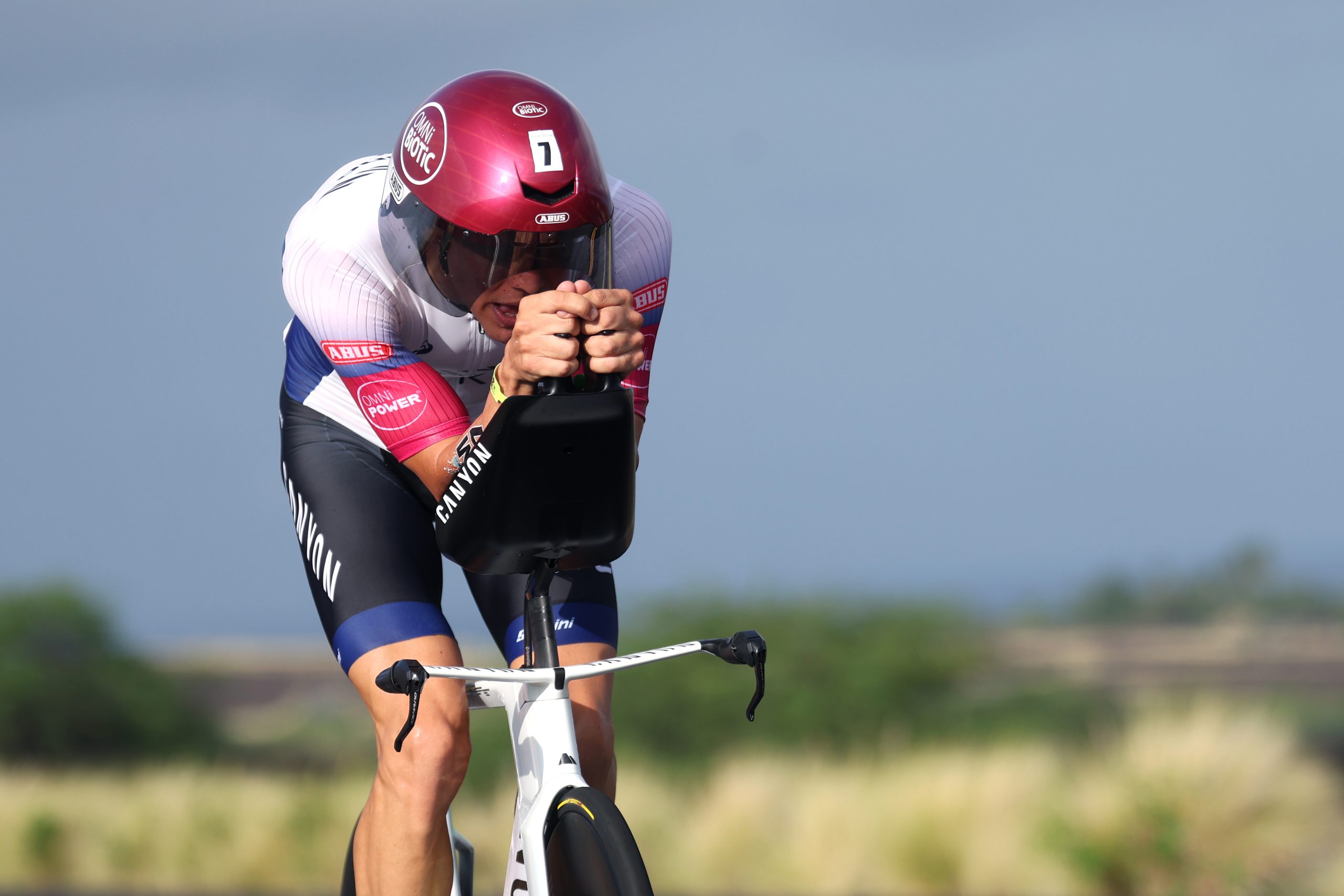
On the climb he started to lose time to the chasers, maybe his hard first 90 minutes caught up with him. He reached the turnaround first, still 53 seconds ahead of Matthew. After the turn the cramps came “suddenly,” and he had to pull himself together just to make it back to T2, trying to stretch on the bike as he rode. Once Matthew, Magnus and Gregory had passed him in short succession, he was not able to hold on, and on the long way back he dropped through the field. He reached T2 in 19th, having lost more than thirteen minutes to Magnus since Hawi.
But Jonas has shown before that a tough end to the bike doesn’t mean a bad day. At the 2025 World Championship in Nice and in Roth this year, he struggled through the last hour on the bike and still bounced back with a solid run. Kona was no different. “I didn’t give up, I think that’s the message,” he said afterwards. Within the first twelve kilometers of the run he moved up ten places, and by the top of Palani he was already ninth. Pierre, whom he had passed early on Ali’i Drive, came back past him on the Queen K, and Jonas was tenth at the Energy Lab turnaround. From there he continued to move forward as others faded. Shortly before 40 kilometers he passed Kristian and went on to finish seventh, 9:15 behind Vincent. His 2:41:45 marathon was the fifth-fastest of the day.
Eighth: Kristian Blummenfelt
Kristian came to Kona as one of the big favorites, and for 25 kilometers of the marathon he looked like a contender. “Disappointed” was his one-word summary.
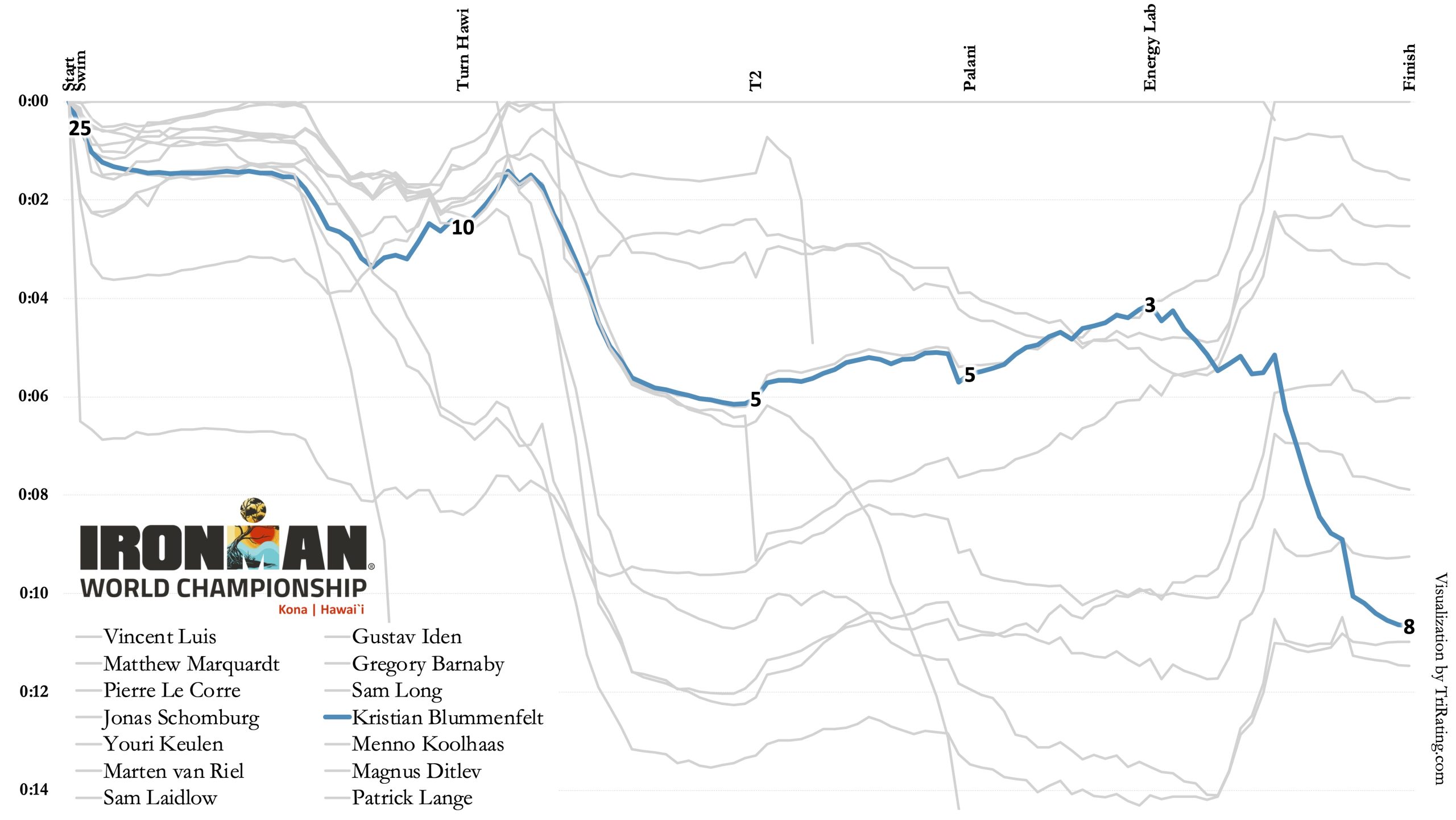
His swim was harder than it looked from the outside: Kristian hung at the back of the large front group, close to being dropped. After about 2.5 km a gap opened, and he had to work hard to bridge back up to the front, the surge that dropped Gustav. Kristian came out last of the lead group, 31 seconds behind Marten. On the bike, he needed a while to find his rhythm. Early on the Queen K he was at the back of the big chase group, and by Hawi he was 2:32 down. On the way back he caught up with Vincent, together with Gustav and Marten. When Vincent asked him “what took you so long?”, Kristian blamed the wind. They reached T2 together, 6:02 behind Magnus.
Kristian felt good on Ali’i Drive and stuck to his plan: hold back early, then accelerate on the Queen K. Only Gustav ran faster in the first half. At halfway he was second on the road, 4:36 behind Magnus and just ahead of Vincent. The two former ITU rivals then swapped places for several kilometers, but they weren’t gaining much on Magnus. When Vincent remarked on that, Kristian just answered “yes,” and to Vincent, who has raced him for 15 years, that already sounded like a lack of confidence.
In the Energy Lab, Kristian was reluctant to share the pace-making into the headwind, and Vincent pushed on alone. Kristian couldn’t respond. By his own account he “snapped” on the way down into the Energy Lab and knew immediately that he was in trouble. Entering it, he felt he urgently needed fluids, but “I was probably too late.” Within three kilometers Vincent was more than a minute clear. Gregory, Gustav and Matthew came past before 30 km, and on the long way back Pierre, Sam Long and finally Jonas passed him too. After a first half of 1:20:59, the second half took him 1:28:07, and his marathon of 2:49:06 dropped him from second to eighth place.
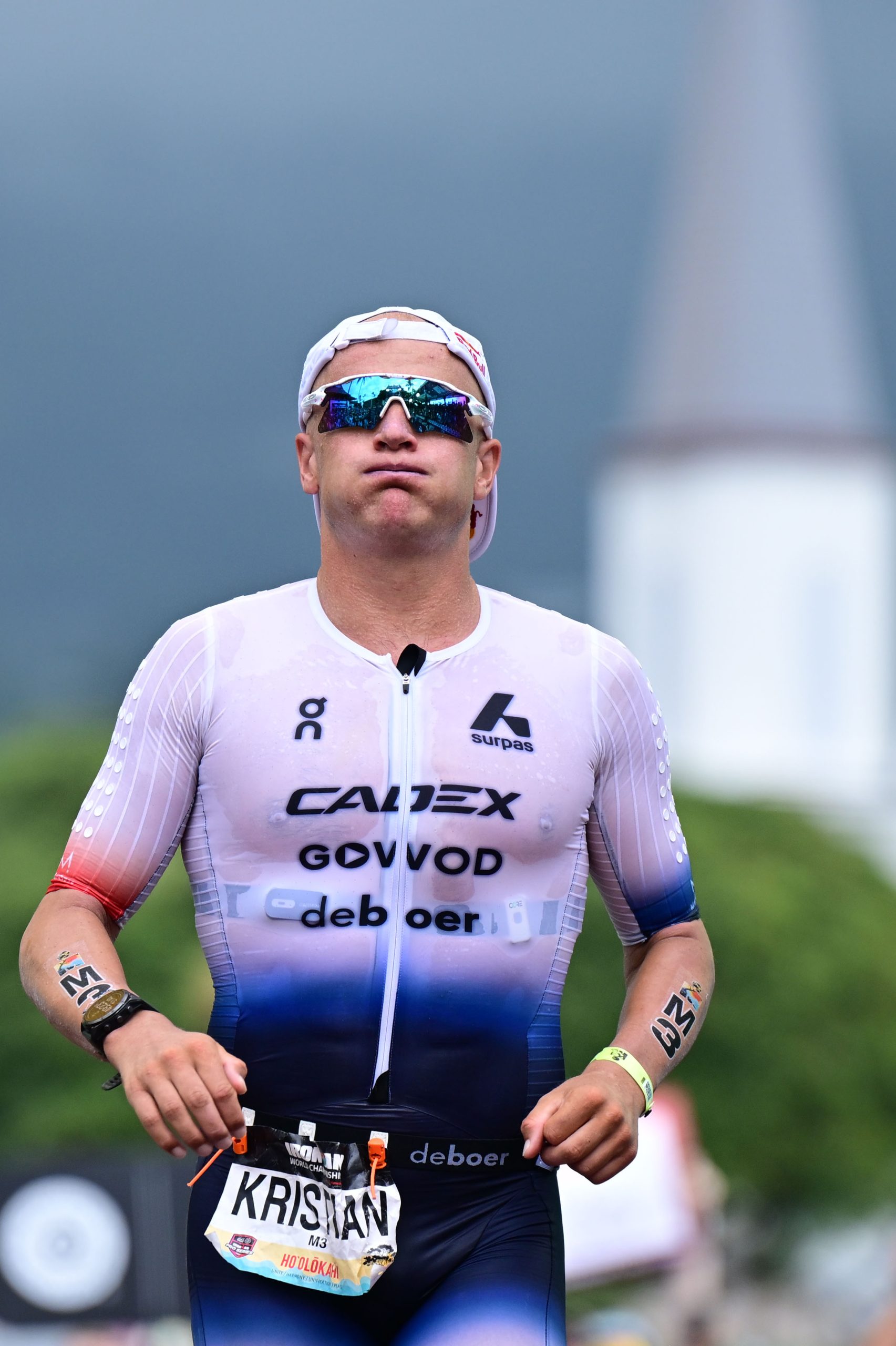
Even on a day that didn’t go according to plan, his thoughts went to his training partner. After about 40 km, as Kristian struggled towards the finish, his first question to people at the roadside was how Gustav was doing. The answer was good news: Gustav was about to finish second and would win the Ironman Pro Series, with Kristian himself holding on to third in the standings. His own lesson was a simple one, more fluids and less focus on carbs at special needs. “Live and dream for another year,” he said.
Ninth: Youri Keulen
Youri made his Kona debut alongside his training partners Vincent and Marten. He had planned his season so that he could do the whole Kona preparation with them. He knew beforehand that he would have to “go to a dark place to truly understand what it means to ‘race’ Kona.”
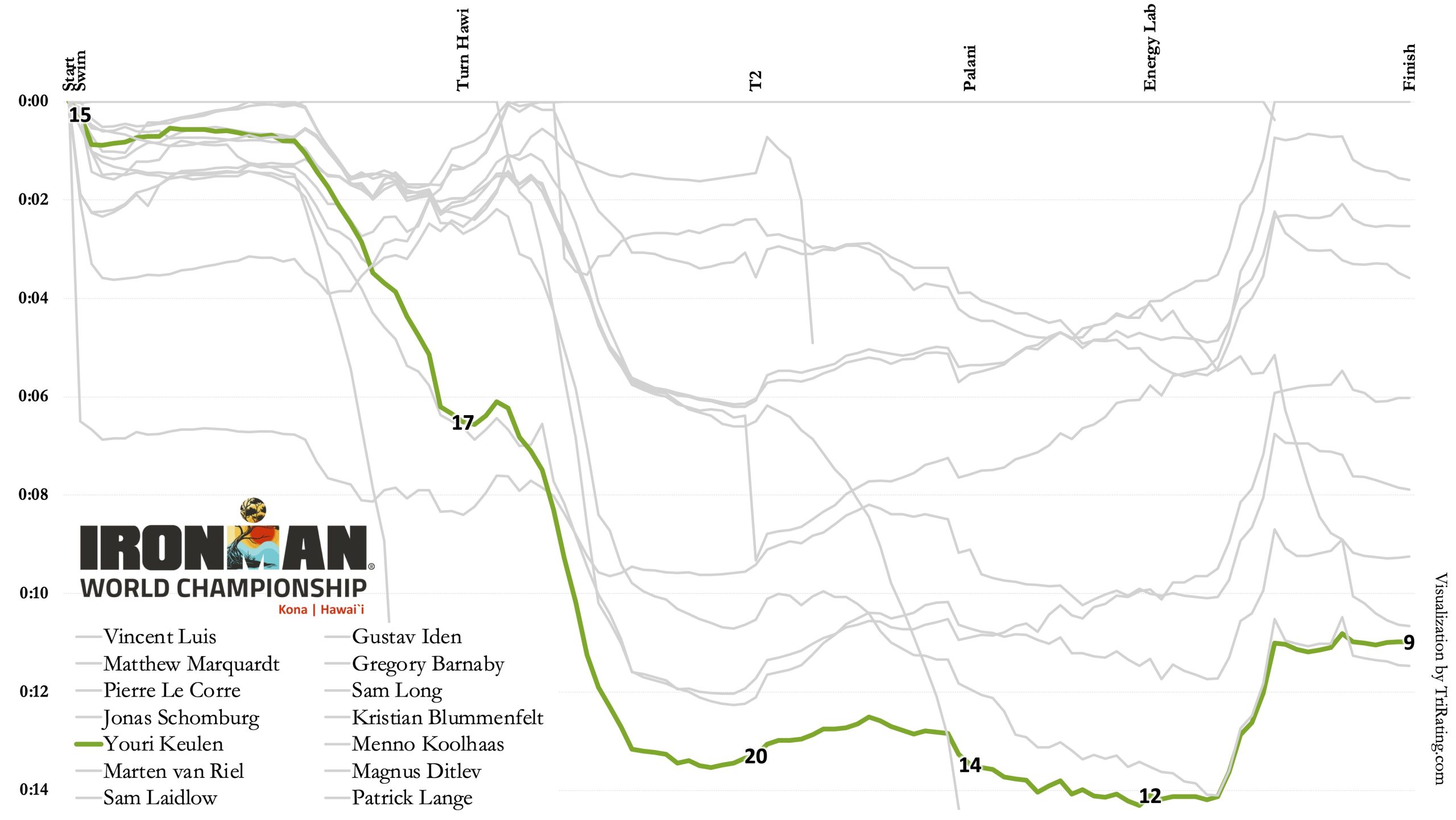
His swim went well. After 48:32 he rode in the front chase group through town and was only 48 seconds down after 20 km. But then the bike became a struggle. On the Queen K he let the front go and tried to stay patient and stick to his power. At Hawi he was 6:30 behind, and on the way back he lost more time, reaching T2 in 20th, 13:17 behind Magnus.
The run was where his patience paid off. His 2:42:05 marathon was the sixth-fastest of the day. By the top of Palani he had moved up to 14th, and at the Energy Lab he was 12th. From there he slowly reeled in Menno, passing him at about 40 km to take ninth place and finish as the first Dutchman, 10:59 behind Vincent. One of his training partners had won the race. Marten, whose own day fell apart, called Youri’s ninth place “a crazy Kona debut.” Youri himself looked back on his race as “a great first taste of what Kona really means.”
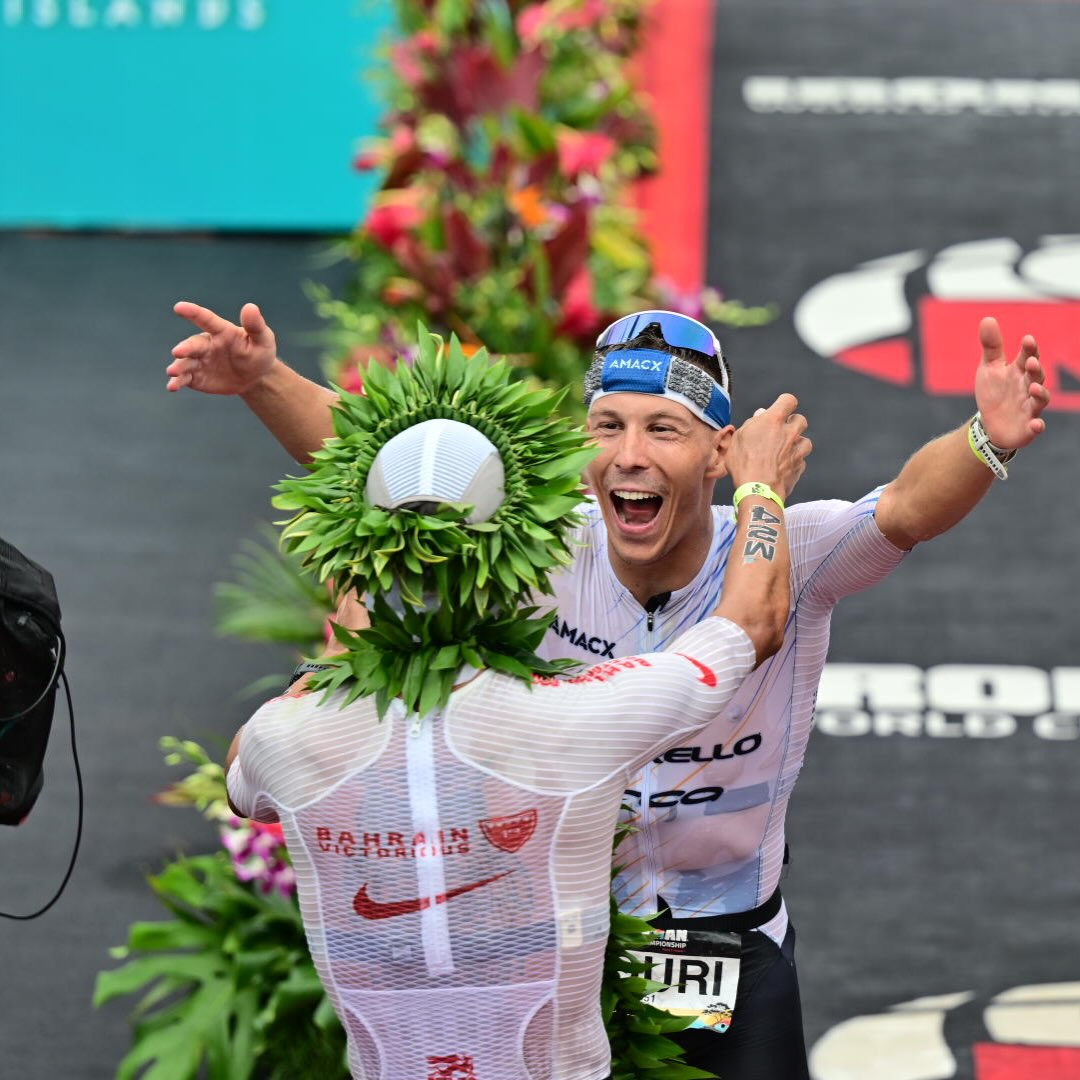
Photo Credits: Instagram @youri_keulen
Tenth: Menno Koolhaas
Menno was at the front from the very start. He came out of the water second, one second behind Marten. His 1:57 was the fastest T1 of the day, so he started the bike in the lead. He led through town until Jonas caught him at around 20 km. After 30 km Jonas rode away for good, but Menno stayed with the chase group of Marten, Matthew and Sam Laidlow, about one minute back after 40 km.
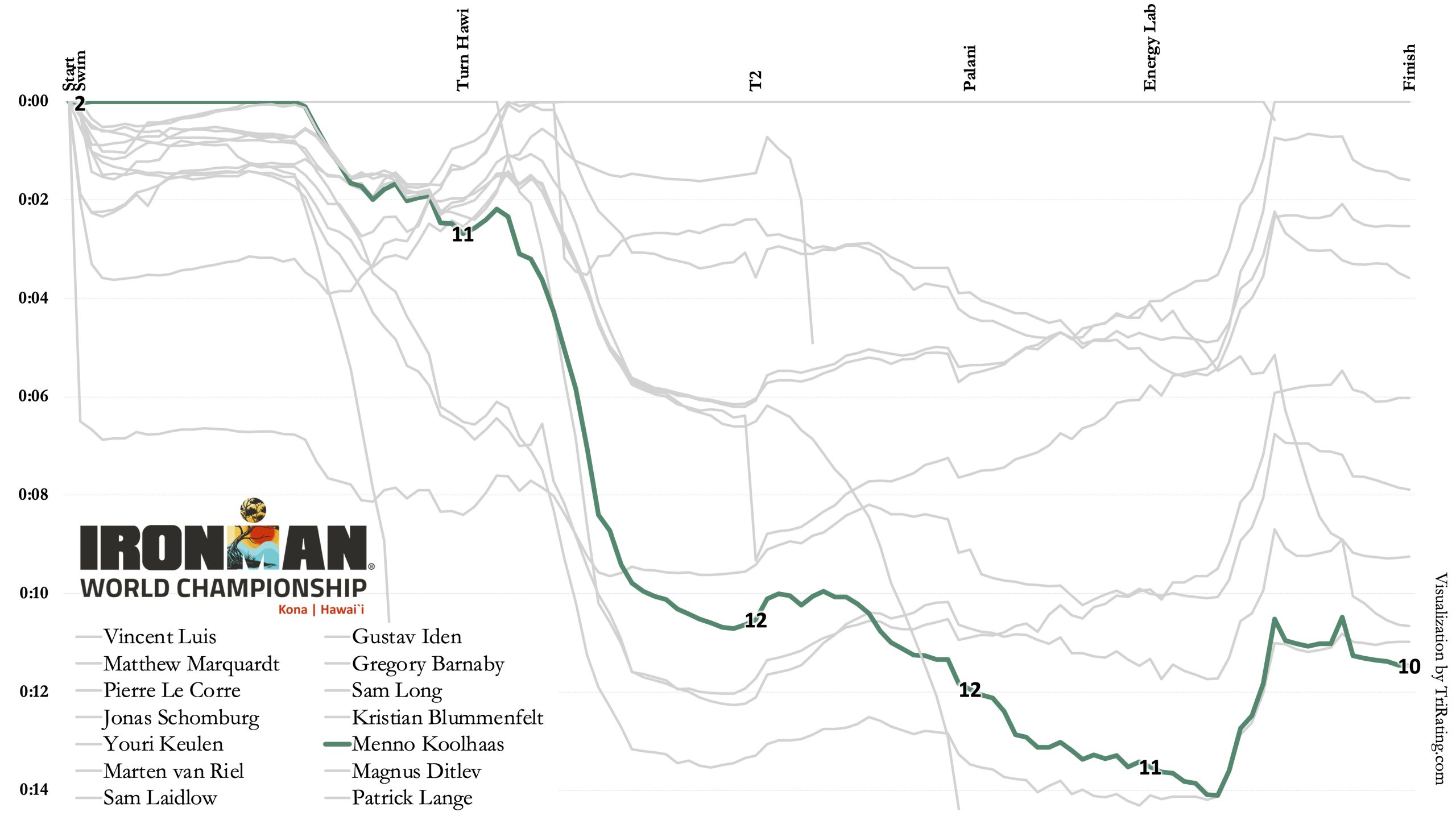
From there the gap grew steadily, and Menno reached Hawi in 11th, 2:41 behind. Shortly after the turnaround, “the power went out of my legs, and I just couldn’t push anymore.” The long way back into town was a mental struggle, and he reached T2 in 12th, 10:31 behind Magnus.
On the run he could feel straight away that he didn’t have his usual running legs. By 16 km he had lost almost another two and a half minutes to the leaders, and he was still 12th at the top of Palani. He fought on, moved up to 11th by the Energy Lab and held on to finish tenth, 11:28 behind Vincent, after a 2:45:31 marathon. Youri had passed him in the last kilometers, and Menno wasn’t happy with his final result: “I came here aiming for more.”
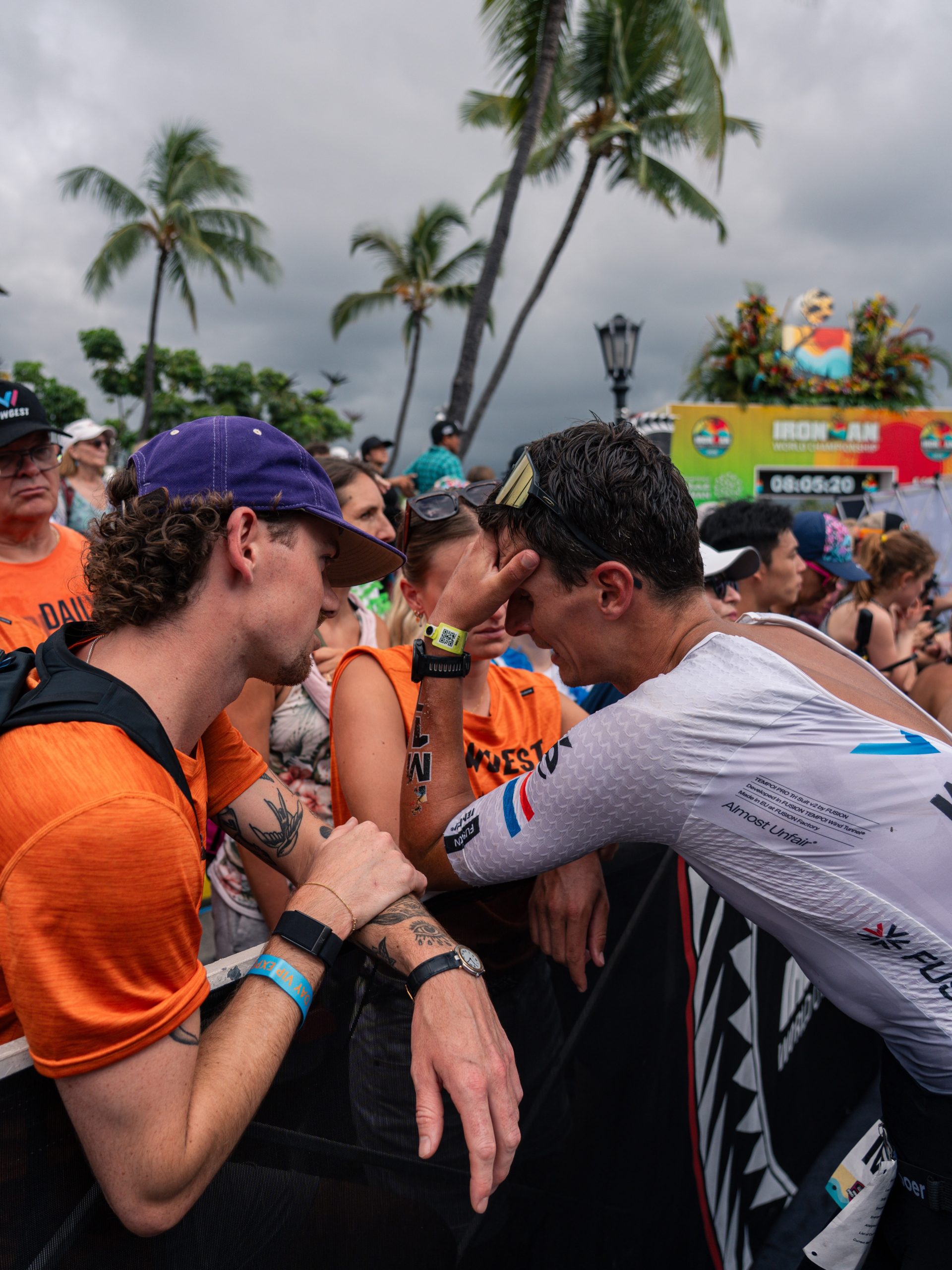
Photo Credits: Instagram @mennokoolhaas
Fading on the Run: Marten van Riel
Marten arrived in Kona with question marks. He had been ill before the 70.3 World Championship in Nice and, by his own account, dug himself “a proper hole.” Eight days before the race he was still “super, super tired.” By race week he sounded more positive: “the last couple of days I’ve been doing some decent trainings.” His target was cautious: “Even if maybe it’s not this year for the win, I still hope.”
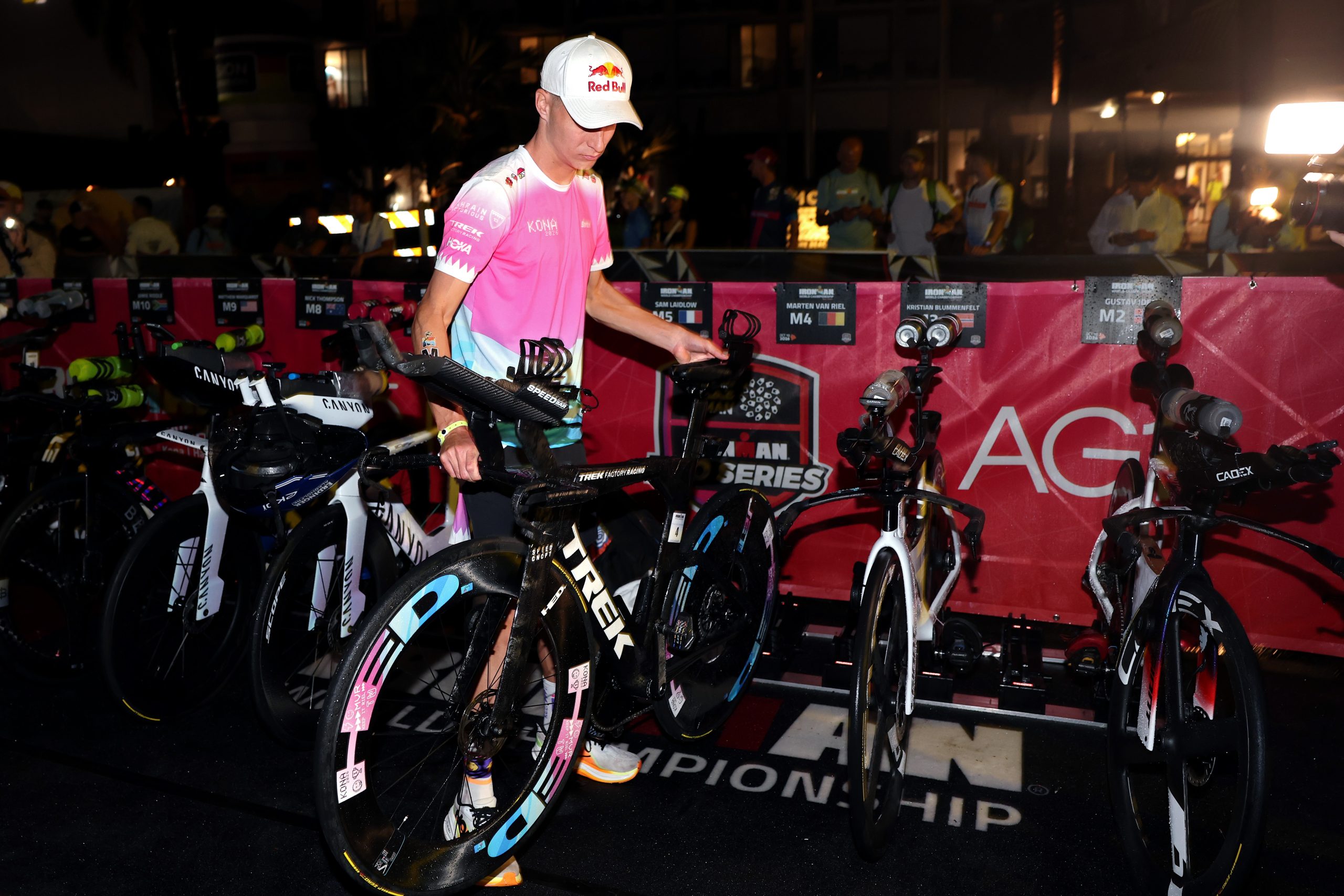
His training group with Vincent and Youri had planned to “push the swim a little bit,” and Marten delivered: he was first out of the water in 48:17 and second onto the bike behind Menno. He rode in the chase group behind Jonas to Hawi and reached T2 6:30 behind Magnus, only about half a minute behind Vincent and Kristian.
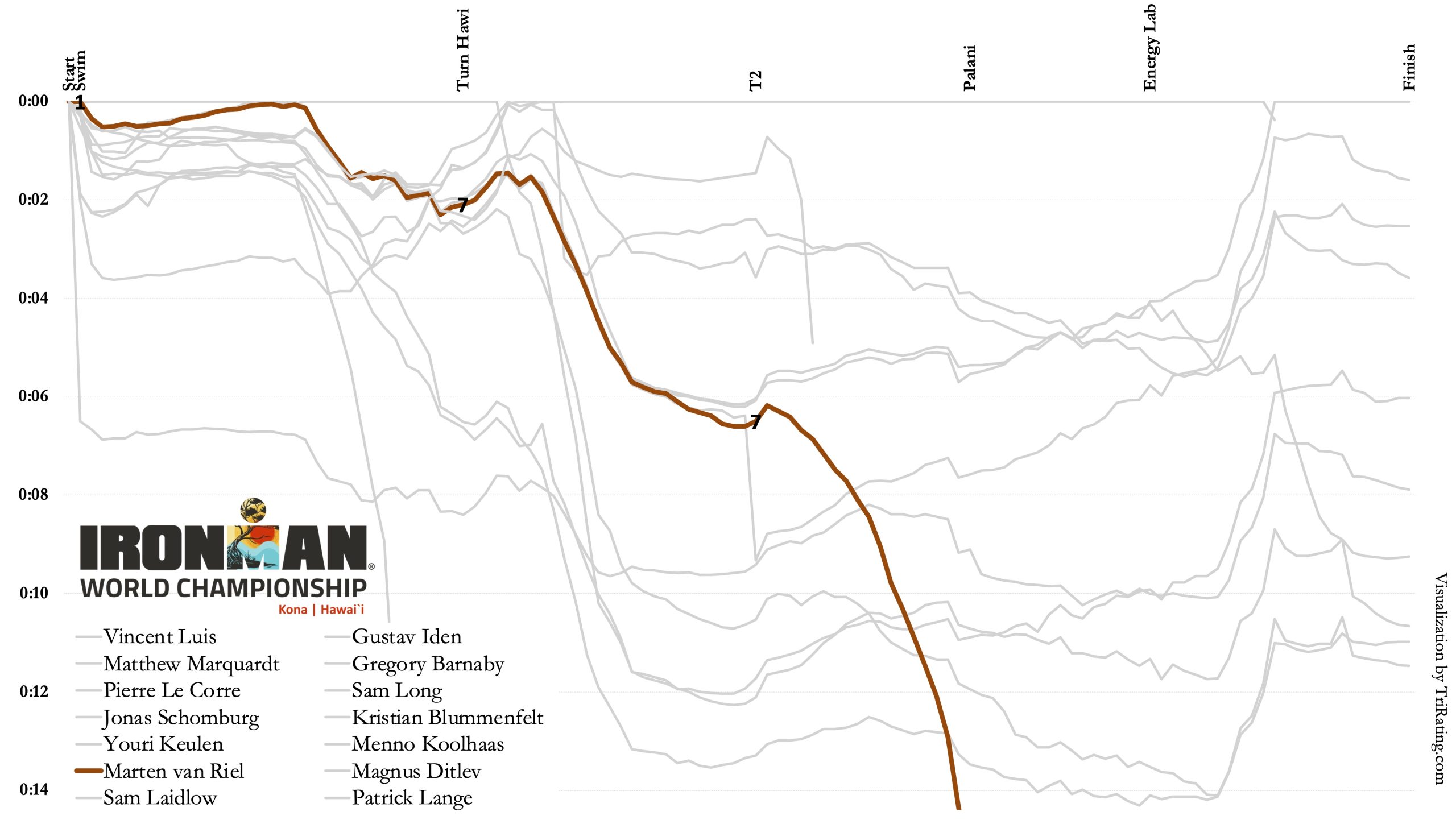
But then Marten never found his running legs, and after Ali’i Drive he started to fall further and further behind. He kept going and finished 36th after a 3:32:49 marathon, almost an hour behind Vincent.
Afterwards he was “disappointed but inspired.” He was leaving the island empty-handed (“I somehow didn’t even get my finisher medal”), but with gratitude, having seen his training partner Vincent “put a massive crown on his career. The fire is only burning harder now.”
Early DNF: Patrick Lange
Patrick, Kona Champion in 2017, 2018 and 2024, came to Kona for the last time. His farewell ended at the Hawi turnaround after three and a half hours.
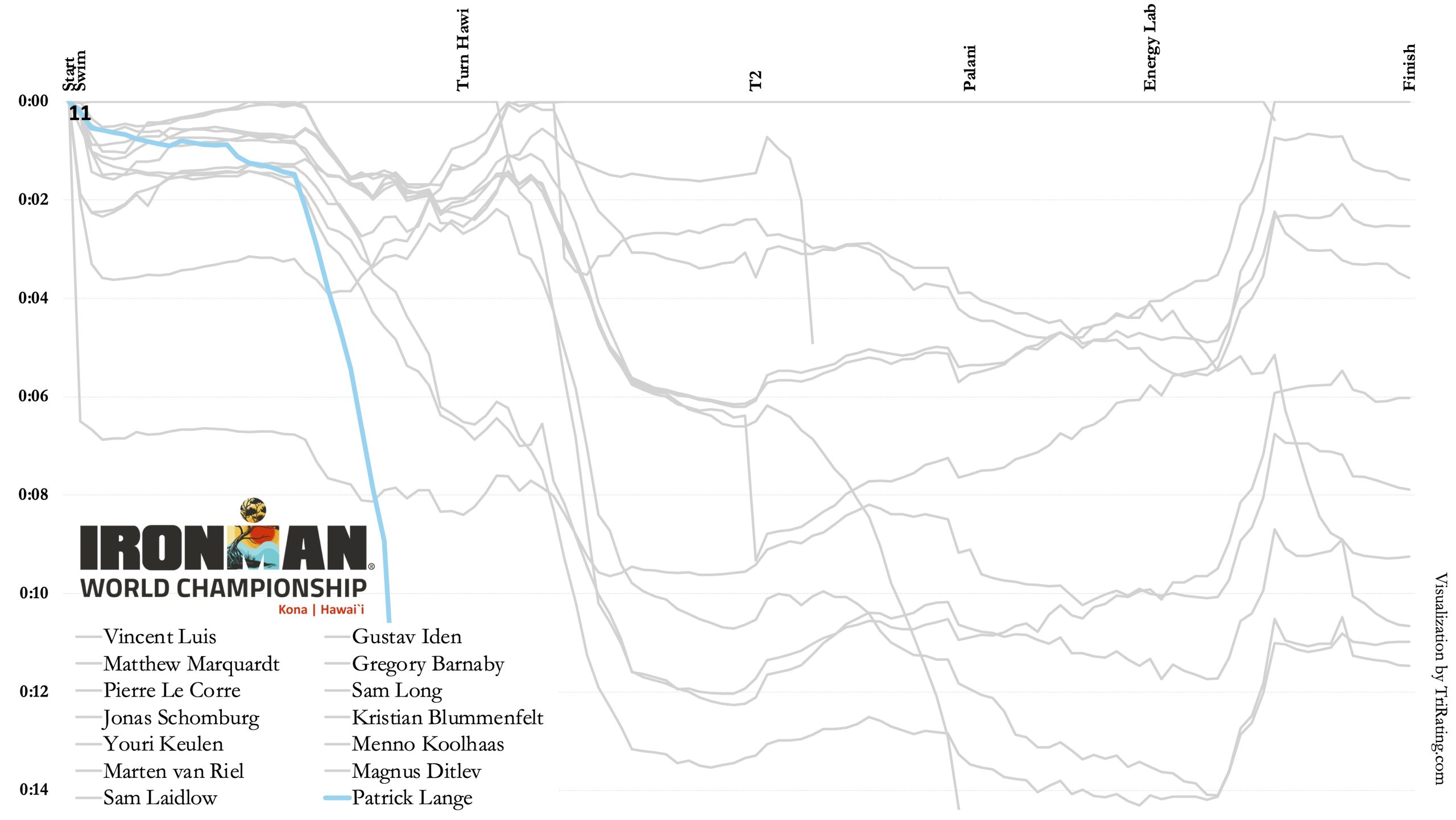
It started well: “I had a great swim.” Patrick was only 12 seconds behind Marten out of the water and fifth onto the bike, then rode through town in the chase group about 50 seconds behind Menno in the lead.
After about 20 km he was riding at the back of his group as Gustav came through. At 27 km he was still only 12 seconds behind Pierre, the eventual fifth. But soon after reaching the Queen K his muscles began to cramp. By 32 km he had lost contact with the group.
From there he fell further and further behind. He thought it was a familiar problem and drank about six liters of water and electrolytes, but “the muscles did not soften up.” In Kawaihae he stopped for about three minutes to talk to his coach, then “pulled himself together” for the climb to Hawi. But “there was no power at all, I could push maybe 160, 180 watts.” He reached the turnaround more than 23 minutes behind Jonas, near the back of the field, and called it a day: “I simply could not imagine running a marathon on those legs.”
Instead of going home, he handed out ice on Palani Road, “to make it a little easier for those who hopefully will reach the finish line.” A “hard pill to swallow,” as Patrick put it. His career isn’t over yet: his last race will be Challenge Roth next summer.
DNF on the Run: Sam Laidlow
Sam, second in Kona 2022 and the bike course record holder, knew after about ten minutes on the bike that something was wrong. “The first 10 minutes were OK, then I realized that the blood wasn’t getting to my leg.” His left leg wasn’t getting enough blood, a problem he has known about for a while: iliac artery endofibrosis, common among cyclists.
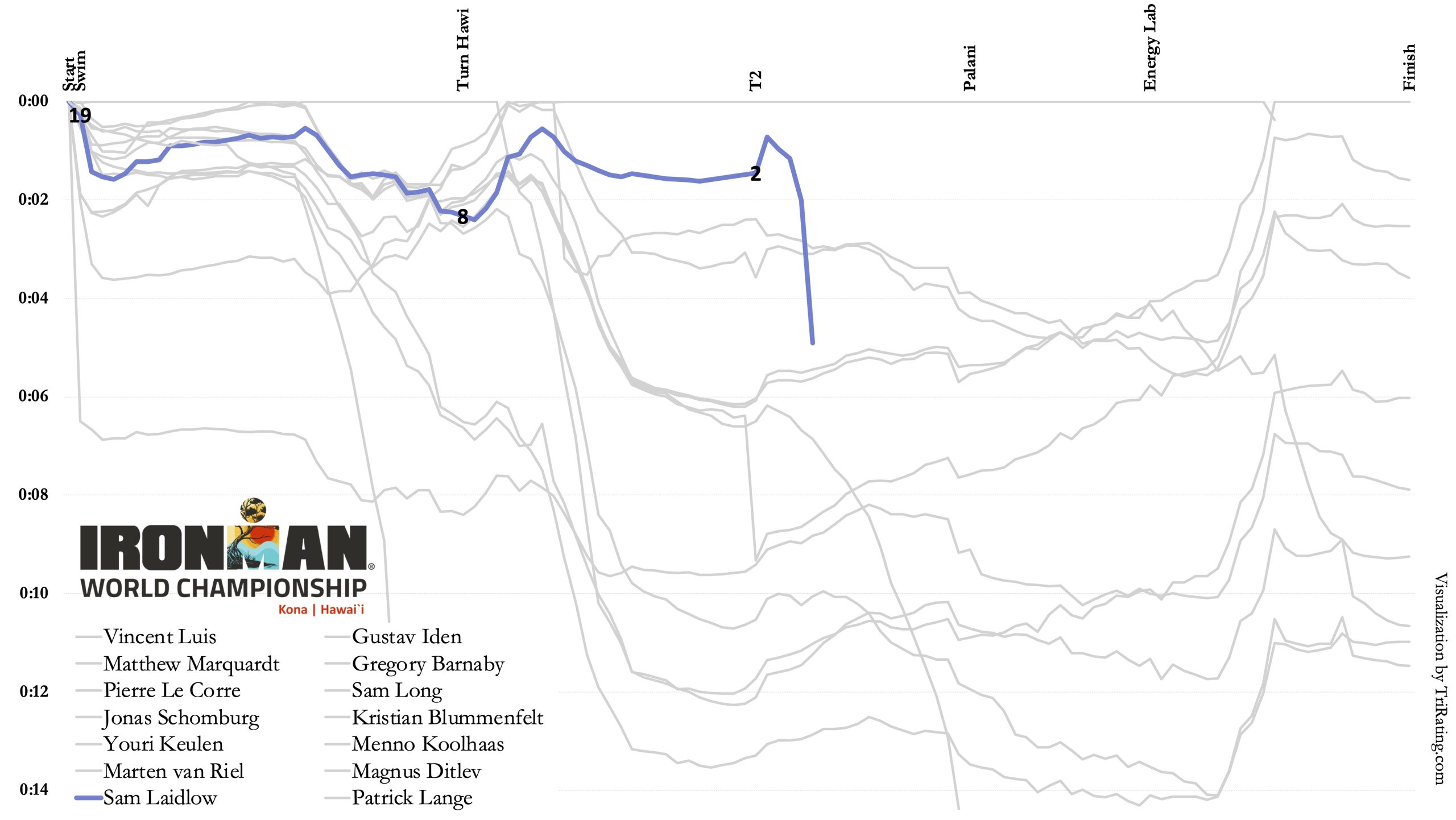
His swim had gone well: 48:33, with the lead group. A slow T1 left him 1:25 behind Menno at the start of the bike, but he was up with the front chase group by Kawaihae. To protect the leg he rode out of the saddle a lot and pushed harder with his right leg, about “280 … 30, 40 watts off what I wanted to do.” According to Vincent, Sam and Matthew were still attacking each other on the way out.
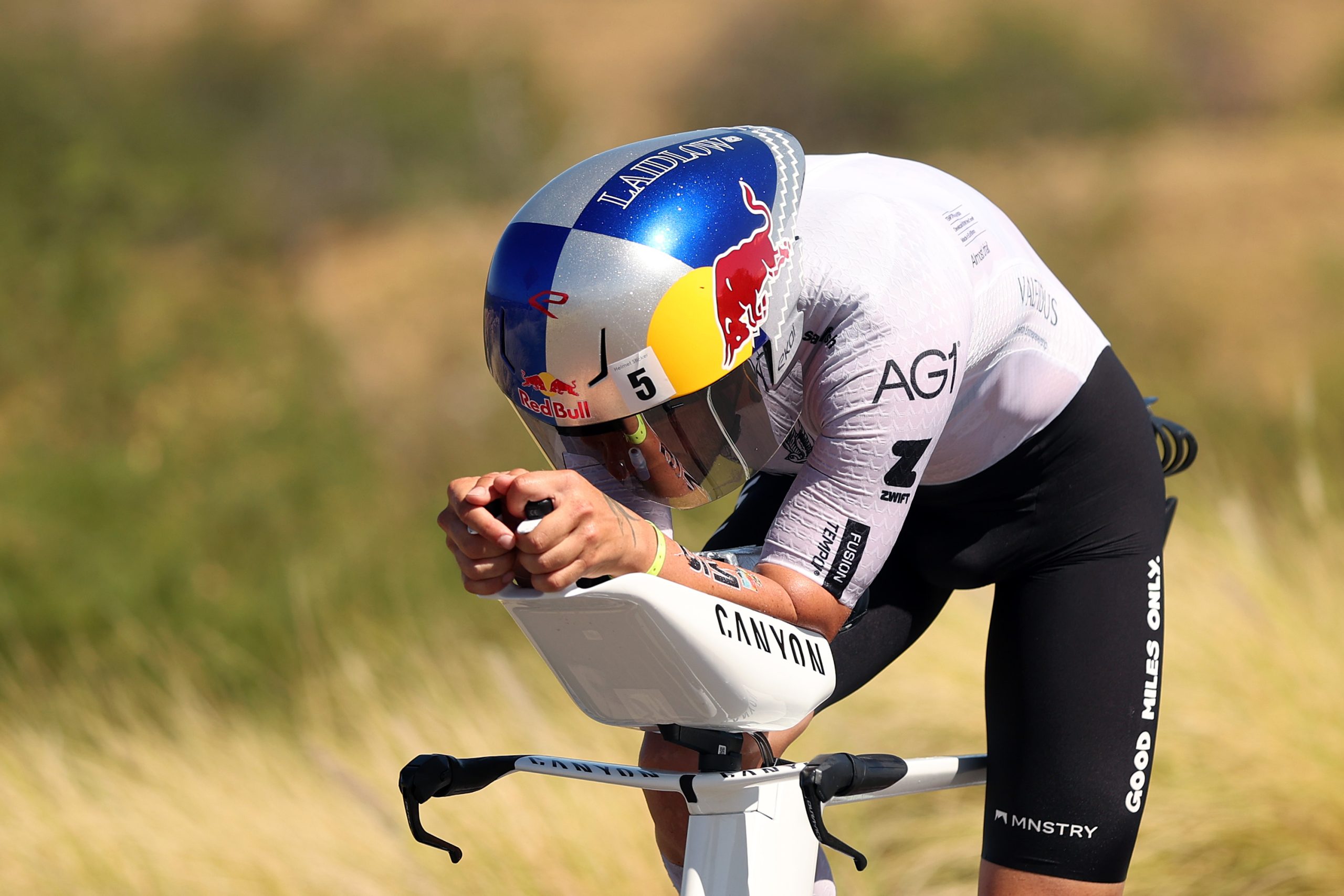
On the climb to Hawi he lost contact and reached the turnaround 2:19 behind Jonas. “I was really close to pulling out already up in Hawi.” Instead he rode back into contention on the fast sections, knowing “I’m pretty aero.” By 130 km he was only 43 seconds behind the lead group. He finished the bike second, 1:27 behind Magnus, with the second-fastest bike split (4:10:08). “I’m surprised that I came off second. But it means nothing if you can’t run.”
A quick T2 cut the gap to 43 seconds, but it didn’t matter. “As soon as I got on the run, my whole leg was numb.” He loosened his shoe and took off his sock, but “just couldn’t get the blood there.” After 2 km he was already two minutes behind Magnus; he needed more than five minutes for the next 800 m and stopped on Ali’i Drive after 2.7 km.
His verdict: in earlier races, getting through the bike meant the run would be OK, “and I think this time I took it too far, pushing through that pain on the bike.” He plans to have surgery in France as soon as possible.
Late DNF: Magnus Ditlev
With 12 km to go, Magnus still led by more than three minutes. Then, in his own words, “the lights went out.”
After a difficult first half of the season, Magnus had “the best camp in my entire life” at altitude before Kona, setting personal bests in all three disciplines. He arrived confident, but without the attention his second place in 2024 might have earned him.
The swim was the one part he was disappointed with. He was “second guy when the split happened” and couldn’t close the gap. That left him 2:01 behind Marten, his biggest deficit in a world championship swim. (Two years ago at Kona 2024 he was 76 seconds back.) In T1 he took the time to put on aero calf sleeves: “If I lose another 10 to 15 seconds, then that’s worth it.” He started the bike 3:18 behind Menno.
He had learned from 2024, when he and Sam Laidlow “were just hammering the first part of the bike” and Magnus “collapsed on the way home on the Queen K.” This time he rode “my own steady pace” from the start. He was 2:17 behind Matthew at the start of the bike and was 2:54 down after 30 km, but from there the gap began to shrink: 1:50 at 60 km, 27 seconds at Hawi. Magnus had planned on “a really strong last hour” and wasn’t expecting to gain time this early, so the splits from his agent around 50 km came as a welcome surprise. At the turnaround he was already ahead of Sam Laidlow and Menno, and after 110 km he had caught Matthew and Gregory. After about 140 km he rode away from them: “I just rode my steady power all the time and people were just not able to hang on to my wheel.” With the fastest bike split of the day (4:06:47, more than nine minutes slower than Sam Laidlow’s bike course record), he reached T2 with a 1:27 lead.
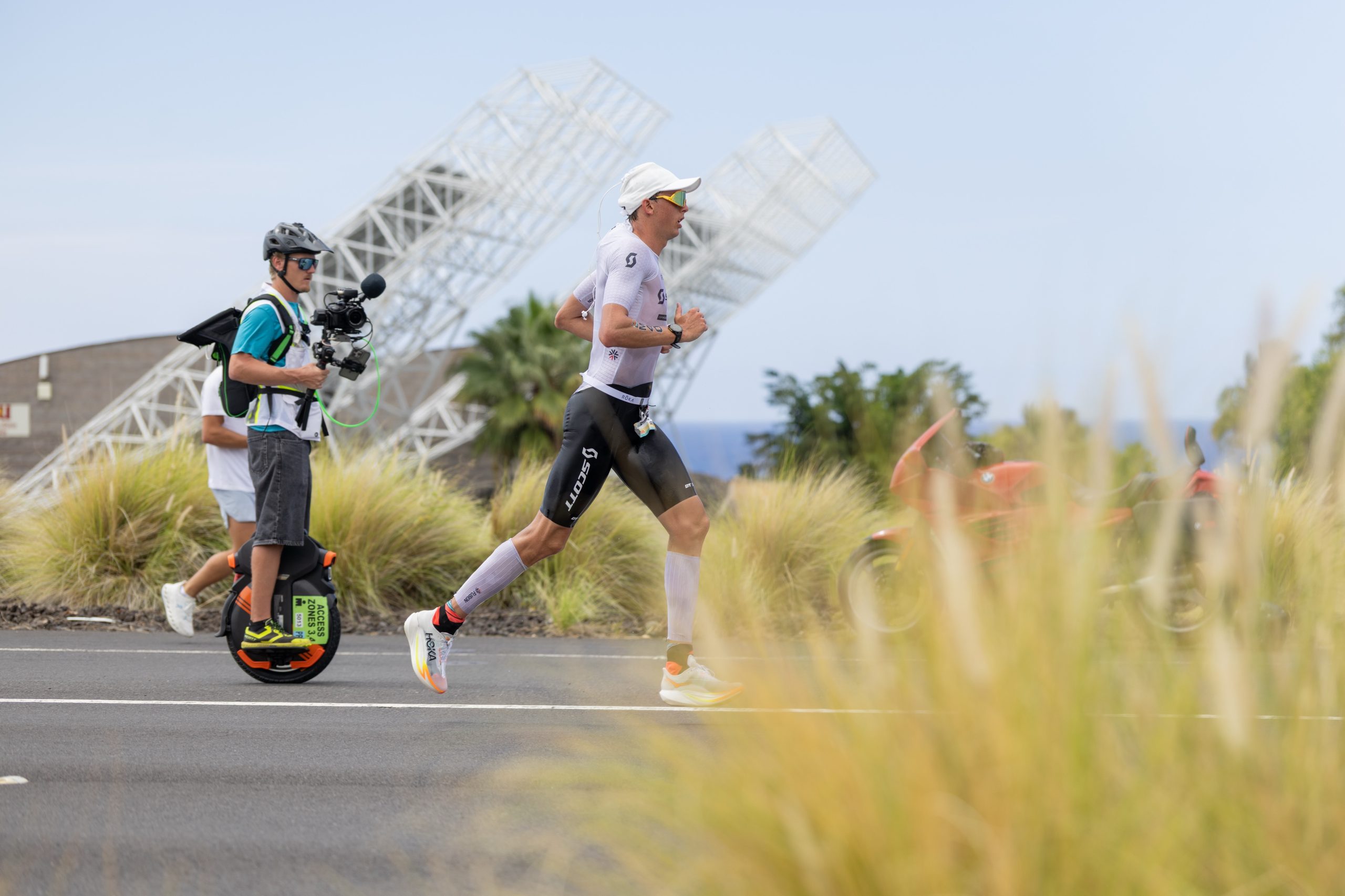
On the run he felt “incredible. I couldn’t even feel that I had been swimming and biking before.” His heart rate was below target. Matthew and Gregory had started the run 2:43 and 3:00 behind him; by halfway the gap was about five minutes. Only Vincent was running slightly faster, closing down his gap from 5:34 to 4:47.
After the Energy Lab turnaround Magnus noticed “some weird sensations that I’ve not really had in a race before.” By the exit of the Energy Lab he couldn’t run in a straight line and didn’t hear his coach shouting. His lead over Vincent melted from 3:31 at 30 km to 1:10 after 33.2 km. Vincent passed him at about 34 km, and shortly afterwards Magnus stopped by the side of the road. “I think I stopped just before it went very downhill and very dangerous.”
His main theory: overheating that his cooling hid from him. “I didn’t feel hot.” In heat-chamber tests, very aggressive cooling had left his core temperature almost as high as no cooling at all, while it felt much better. The morning rain and the humidity afterwards may have tipped the balance. With hindsight, he says he should have run “five seconds slower per kilometer.” But he wasn’t running recklessly. Up to 30 km, Magnus was exactly as fast as Jonas, who went on to run a 2:41:45 marathon. Had Magnus held his pace like the others did, he would have been heading for a marathon of around 2:40–2:42, and a win by several minutes.
Even after his frustrating DNF, Magnus leaves Kona more confident than he arrived: “I actually know that I have what it takes now to win the race.”
 Previous Winners
 Course Conditions
 Update: After moving the Saudi T100 to 2027, the men’s Pro field was added to Dubai which will now have a male and female Pro race.